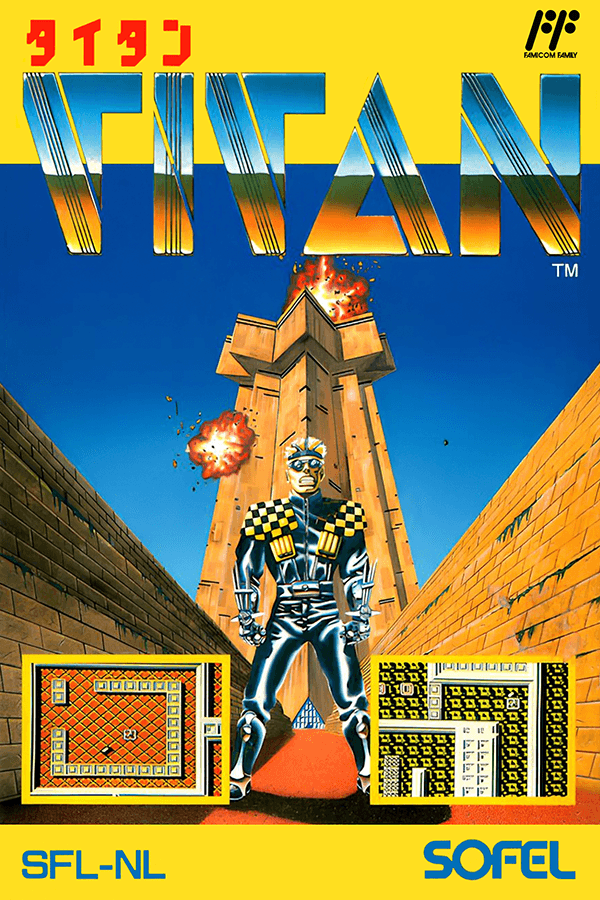
Titan
aka タイタン
In Titan, you do not control the ball directly; you pilot a fragile square that has to nudge, catch, and steer a runaway sphere through 80 dead-end labyrinths.
The indirect physics that make Titan a test of nerves
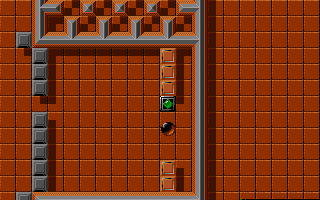
Most Breakout variants give you a paddle at the bottom of the screen and a clear view of where the ball is going, but this 1989 MS-DOS game turns that basic template into a maze crawl. Playing the DOS version of Titan means managing two objects at once from a top-down viewport: the powerball cruising diagonally at a constant speed, and your small control unit scrambling to get into position before the ball escapes off-screen or bounces into a hazard. You are constantly setting up bank shots while trying not to run your own ship into a wall.
The core trick to surviving is learning how to catch. If you move your control unit over the moving ball fast enough, you trap it inside your square, giving you a brief moment to breathe and aim a fresh shot in any direction. If you miscalculate the timing by a fraction of a second, the ball bounces off your edge at a wild angle or passes right through you, straight into a cluster of deadly tiles.
Labyrinths built out of growing walls and deadly hazards
Clear every level by smashing all the destructible blocks or by guiding the ball to the level exit for a 1,000 kronurs bonus. That simple goal gets mean fast inside Vegapolis. The 80 labyrinths scroll in all directions, hiding hazards just off the edge of your sight until you are already moving too fast to avoid them.
The maze tiles actively fight your progress:
- White skulls kill your control unit or destroy the powerball instantly on contact, costing one of your nine starting lives.
- Green skulls snap the ball out of existence, but your unit can safely run over them to clear the path.
- Teleporters instantly swap the locations of your ship and the ball, often dumping your control unit right into a narrow dead end.
- Growing floor tiles harden into impassable solid walls every time your unit drives over them, accidentally trapping you in your own tight corridor.
You can push certain wall pieces around or smash them with your unit to open up short cuts. When the action gets ridiculously fast, holding the space key slows the whole engine down to give your fingers a chance to catch up. That emergency slow-motion button is not a cheat; it is the only way most players ever cleared the later, tighter layouts.
A difficult Titus France SA project built under pressure
Programmed by Alain Fernandes with design contributions from Eric Caen and Philippe Pamart, the game hit store shelves courtesy of publisher Titus France SA. Production at the studio was notorious for tight deadlines and high stress, leading to developer departures around 1989. That hurried environment shows up in the sharp, unyielding difficulty curve. Period reviewers split hard on the results: ST Amiga Format praised its speed and visual style with a 79% score, while The Games Machine handed out a brutal 41% over its repetitive level structure and tricky handling.
Compared to other action puzzle titles from 1989, the sheer speed is what catches people off guard. On a high-end AT rig, the ball flew across the screen so quickly that micro-adjustments were almost impossible without relying on the space key slowdown. The game relies entirely on your ability to predict bank ricochets while constantly checking your immediate surroundings for growing walls.
Steer the sphere today
The early levels teach you how to trap the ball reliably, but by level ten you will be slamming the space key just to survive teleporters that drop you directly into skull hazards. The grid layout leaves zero room for sloppy steering, and a single missed rebound usually costs a life instantly. If you enjoy precision top-down spatial puzzles that test your reaction time, it is still a tough, brutal challenge to crack.
You can play Titan free in your browser right here on this page, with zero installation or extra setup required. Launch it, hit the keyboard controls, and see how many labyrinths you can clear before running out of lives.