

Unreal
Rate this game
- Played
- A lot
Unreal throws you back and forth between sweeping dragon flights over roaring lava lakes and punishing hack-and-slash platforming on foot, creating an action game that was visually ambitious for 1991 even if its MS-DOS port lost a bit of magic along the way.
Riding dragons and fighting with comet-forged steel in Unreal
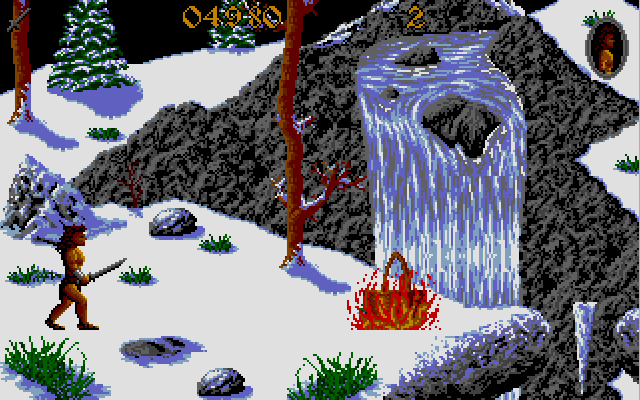
You play as the barbarian Artaban, set on a quest to rescue Princess Isolde from Polymorphe, an evil floating head who commands the dark forces of the realm. The structure splits cleanly across eight stages: five 3D rail-shooter levels where you ride your dragon, Dracus, and three 2D side-scrolling platform stages where you explore on foot. When you fly, you dodge cliff faces, trees, and flying beasts while hurling fireballs. On foot, your primary weapon is an ancient sword forged from a comet, which gains magical properties as you progress. You can light your blade to deal heavier damage, cast fireballs, or shoot water bubbles to quench burning hazards.
The transition between modes keeps the pace changing, but the foot levels bring strict environmental puzzles and hazardous leaps. You will find yourself striking suspended boulders to release water over fires or timing jumps across dangling lianas over instant-kill gaps. Navigating terrain means watching your footwork carefully; you can slide down snow slopes and jog along rolling hills, but missing a ledge sends you straight into the abyss. Health carries over, though it mercifully gets replenished when you reach the end of a stage.
How the PC translation stripped away the Amiga original's shine
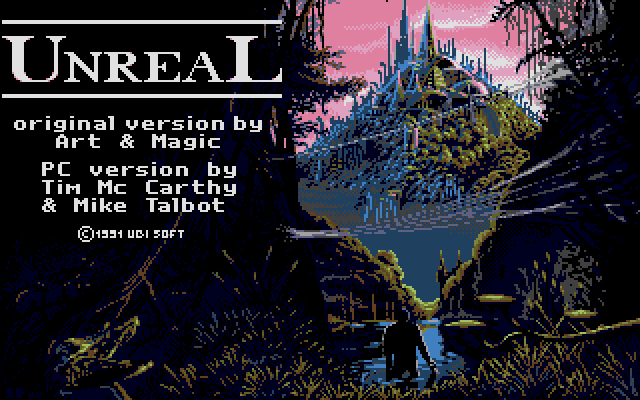
Created by the French team at Ordilogic Systems, the original Amiga release of Unreal made a splash thanks to clever hardware tricks. The developers utilized Extra Half-Brite mode to push 60 colors on the title screen and Hold-and-Modify display modes for the ending screens, pairing those visuals with dynamic audio programmed by Maniacs of Noise composer Charles Deenen. However, when publisher Ubi Soft brought the project over to PC displays, the conversion was handed off to an external contract team without input from the original creators. The result was a heavy downgrade to 16-color VGA graphics that flattened the lush atmospheric lighting.
Audio took a similar hit during the move to MS-DOS hardware. While the Amiga game dynamically loaded digitized environmental sound effects or rich synthetic tunes depending on whether a machine had half a megabyte or a full megabyte of RAM, the PC conversion relies primarily on basic AdLib music. Players who pick up the 1991 DOS conversion miss out on the rich auditory atmosphere of the original setup, getting standard FM synthesis instead of layered environmental soundscapes.
Strict timing, high difficulty, and secret codes
If you ask retro fans about their experience with this release, the conversation quickly turns to how punishing it is. The arcade design requires sharp reflexes, and the dragon-riding sections leave almost no room for error when dodging canyon walls or oncoming enemy waves. Adding to the friction, the engine occasionally halts the action mid-stage to read data from the disk, freezing your movement abruptly before starting up the next section of the path. That unexpected break in rhythm killed many promising runs.
For players who wanted to skip the frustration and see the final showdown against Polymorphe at his castle over the lava sea, the programmers left a backdoor. Typing ordilogicus on the title screen enables a cheat mode that lets you bypass the game's brutal difficulty spikes. It is a trick almost every long-time player ended up using eventually just to see the sci-fi ending teaser screen that hinted at a sequel that never materialized.
- Eight distinct levels split across rail-shooting and sword platforming.
- Elemental sword powers including water bubbles, fireballs, and flame blades.
- AdLib sound support for DOS hardware setups.
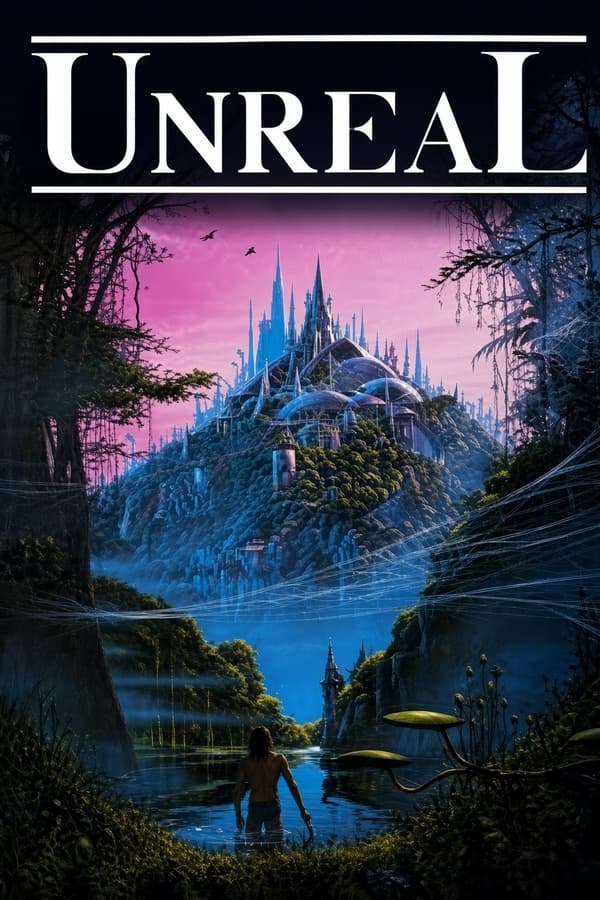
- Cover illustration adapted from Tim White's 1976 fantasy artwork Lord of the Spiders.
Why you should play Unreal online today
The graphics loss on MS-DOS keeps it from topping the visual charts, but this action game works as a curious hybrid of genres. The foot-based platforming gives you plenty of interactive environmental puzzles to solve, while the flight sequences offer rapid-fire dodging that keeps you on your toes. The development team went on to form Art & Magic, applying their visual techniques to games like Agony and later the open-world action title Outcast, which gives this early effort some extra context.
You can play Unreal online right now, running the full MS-DOS game directly in your web browser with no download required. If you want to sample a classic fantasy adventure that mixes Space Harrier style dragon flight with heavy sword combat, fire up a run, keep your sword lit, and remember the cheat code if the terrain gets too steep.
How Unreal is played — the keys the game listens to, grouped by what they do.
- Movement
- Action
- Interface
Highlighted keys are mapped — hover or tap one to see what it does.
Control key map is incomplete as specific direction keys for movement in 2D platforming sections are not detailed in the available text beyond jumping.
Players' controls
Touch and gamepad controls
The on-screen keyboard and gamepad mapping the browser player uses on a phone, a tablet or a controller, as opposed to the real keys above. $PRO members make their own in the player and share them here; anyone can pick one to play with.
Make your own touch controlsPRO
- 1Open the editorSign in below, then pick what to make. The game starts with the editor open over it.
- 2Place your keysAdd keys and drag them where your thumbs rest, or map a controller's buttons. Test plays the game with them; Save keeps them, and you play with them from then on.
- 3Share themShare them right after saving in the game, or name and share them here. Players vote, and the best become this game's controls for everyone.
Go PROSee how it worksSign in+20 XP for sharing · +50 XP if yours become the game's own
- The game's own controlsKeyboardGamepadWhat every player starts with.In use
2 screenshots
From the archive
No reviews yet
Tell the community what you think of Unreal. Reviews are public and tied to your username.
No archived manuals for Unreal yet
No manuals archived for this title yet. Sign in to upload the first scan.
Cheat codes, console commands and memory pokes for Unreal — each one verified and attributed.
Sign in to submitNo cheats yet for this title
Know a working cheat, poke or trainer? Add it with the button above. Moderators check every entry before it goes live.
No archived soundtrack for Unreal yet
No soundtrack archived for this title yet. Sign in to upload the first rip.
No save states for Unreal yet
No save states for this title yet. Sign in to share one.
Discussions
Sign in to post- Threads0
- Total posts0
- Online now6
Community · Unreal
Who's contributing, and what's new
- Reviews0
- Threads0
- Uploadsapproved0
- Contributors0
Recent activity
Nothing here yet
Reviews, discussion threads and approved uploads appear here as members add them.