


Body Blows
Rate this game
- Played
- A lot
When home computers tried to battle arcade cabinets, Body Blows threw its hat into the ring with single-button special attacks and a fighter who apologises after every knockout.
Body Blows brought arcade fighting to single-button joysticks
Back when arcade fighter cabinets used six buttons, home computer gamers were still holding joysticks with just one red trigger. British developer Team17 tackled this limitation head-on when building their original 2D fighter for the Amiga before porting it over as an 1993 PC release. Producer Martyn James Brown, designer Cedric McMillan Jr., and artist Danny Burke crafted a system where holding the fire button filled a meter on screen. Releasing it while standing still unleashed your character's super special attack.
That mechanical shortcut gave PC owners a fighting game they could actually play on standard hardware. Instead of sweeping quarter-circles across a keyboard, you held down the button, watched your energy bar charge up, and let go. The game also implemented a mercy locking feature. When you knocked an opponent down, their fire button locked until their fighter stood back up. That prevented cheap floor-pounding tactics, forcing players to wait for a clean reset.
The transition to the Body Blows MS-DOS game meant DOS users finally got the same loud, colorful brawler that Amiga owners had been raving about. Amiga Computing praised it heavily at launch with a 93% rating, calling it the top beat-'em-up on the system since IK+. Yet sitting down alone against the computer opponent reveals a very different game than playing against a friend on the couch.
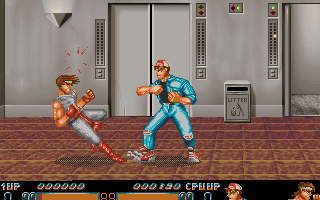
Four heroes against a bizarre roster of rivals
Single-player arcade mode restricts your choice to four playable heroes. You can choose twin brothers Dan and Nik, who play identically. You can pick Lo Ray, a Shaolin monk with quick strikes, or Junior, a British boxer looking for redemption. Taking any of them into the ladder sets up a best-of-three tournament against a strange cast of rivals across distinct environments.
You fight through building sites, dojo floors, wrestling rings, and sunny beaches. The roster you face gets weird fast:
- Mike: A corporate businessman who utters "I'm sorry about that" after beating you.
- Ninja: A masked assassin who relies on swift mobility.
- Maria: A nimble Spanish fighter who tests your anti-air timing.
- Cossak, Doug, and Yit-U: Heavy hitters who round out the ladder before the final confrontation.
The match structure stays simple, but the artificial intelligence in single-player mode scales up viciously. Later opponents read your inputs instantly and punish every missed charge move, turning late ladder fights into grueling tests of patience.
One fire button limits the combo game
The single-button input scheme made the game accessible, but it came at a real cost to tactical depth. Standard attacks depend entirely on which direction you hold while pressing fire. Pushing forward gives you a straight punch or kick, while pushing down yields a low strike. Retrospective reviews often point out that the game lacks the deep combo systems found in console competitors like Street Fighter II.
Because every character possesses only one true special move, matches often devolve into spatial zoning. You poke at range, wait for an opening, hold fire to charge your super move, and fire it off. If your timing is off by a fraction of a second, the AI will punish you instantly. That lack of move variety means single-player runs feel repetitive once you figure out each opponent's pattern.
Where the game thrives is in local two-player versus matches or the built-in tournament mode for four to eight players. When two human players trade blows, the mind games over when to charge a super move create genuine tension. It is flawed as a competitive fighter, but as an energetic home computer brawler, it delivers quick fun.
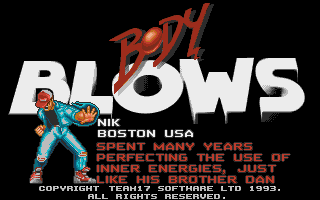
Cheat codes and Sound Blaster tunes made the PC port special
audio support featured crisp digitized voice samples alongside a driving soundtrack composed by Allister Brimble and Danny Burke. Hearing punch effects paired with clear speech synthesis added huge personality to every hit on PC setups of the era. The PC release also contained a secret feature that players passed around schoolyards.
By entering a specific cheat code on the character select screen, you could unlock the final boss, Max, as a fully playable fighter. Max possessed devastating reach and power, making him a absolute blast to use against friends in local versus mode. That inclusion gave the DOS version an extra touch of fan service that original microcomputer releases missed.
How to take on Max without buying a joystick
The single-button control scheme, creative rival roster, and Allister Brimble's soundtrack give this title a distinct place among early 90s computer brawlers. While the steep AI difficulty spikes and limited move lists show their age, landing a fully charged super special move on Mike the businessman still feels immensely satisfying.
You can play Body Blows online right now directly in your browser. You can experience Body Blows free in your browser with zero setup required, letting you charge up a super move and jump straight into a tournament match in seconds.
Players' controls
Touch and gamepad controls
The on-screen keyboard and gamepad mapping the browser player uses on a phone, a tablet or a controller, as opposed to the real keys above. $PRO members make their own in the player and share them here; anyone can pick one to play with.
Make your own touch controlsPRO
- 1Open the editorSign in below, then pick what to make. The game starts with the editor open over it.
- 2Place your keysAdd keys and drag them where your thumbs rest, or map a controller's buttons. Test plays the game with them; Save keeps them, and you play with them from then on.
- 3Share themShare them right after saving in the game, or name and share them here. Players vote, and the best become this game's controls for everyone.
Go PROSee how it worksSign in+20 XP for sharing · +50 XP if yours become the game's own
- The game's own controlsNone yet: played with a real keyboard only.In use
2 screenshots
From the archive
No reviews yet
Tell the community what you think of Body Blows. Reviews are public and tied to your username.
No archived manuals for Body Blows yet
No manuals archived for this title yet. Sign in to upload the first scan.
Cheat codes, console commands and memory pokes for Body Blows — each one verified and attributed.
Sign in to submitNo cheats yet for this title
Know a working cheat, poke or trainer? Add it with the button above. Moderators check every entry before it goes live.
No archived soundtrack for Body Blows yet
No soundtrack archived for this title yet. Sign in to upload the first rip.
No save states for Body Blows yet
No save states for this title yet. Sign in to share one.
Discussions
Sign in to post- Threads0
- Total posts0
- Online now6
Community · Body Blows
Who's contributing, and what's new
- Reviews0
- Threads0
- Uploadsapproved0
- Contributors0
Recent activity
Nothing here yet
Reviews, discussion threads and approved uploads appear here as members add them.