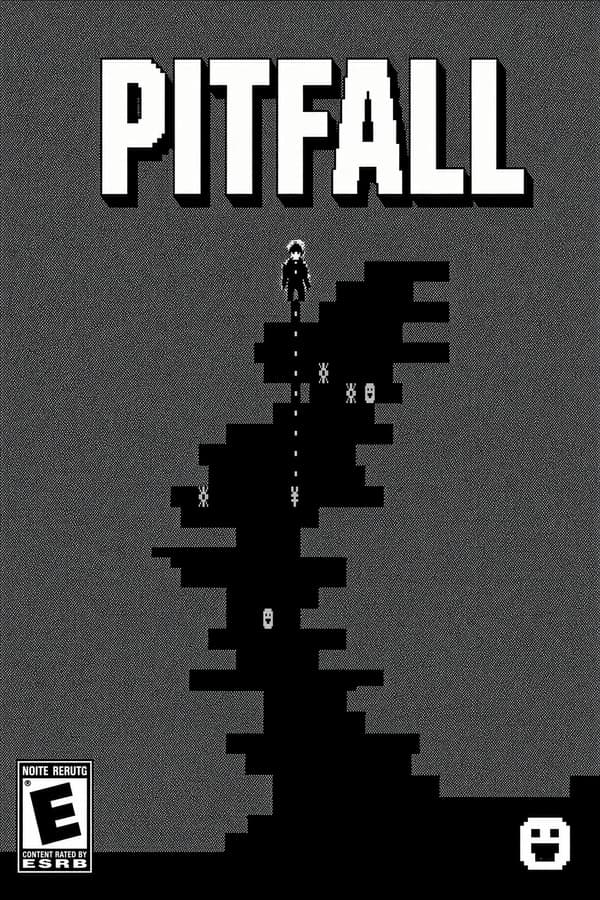
Pitfall
Rate this game
- Played
- A lot
Steering an ASCII starship down a randomly generated shaft in Pitfall requires razor-thin reflexes, precise speed adjustment, and a willing tolerance for brutal instant deaths.
Text characters and unforgiving gravity
In this 1984 release, you are dumped straight into a deep vertical tunnel made entirely of standard text characters. There is no opening narrative or long title sequence to scroll through. Your ship sits near the middle of the screen, and the pit walls rush upward around you as you dive further into the earth.
Your primary controls are straightforward yet demanding. You use the left and right arrow keys to nudge your craft side-to-side, steering clear of jagged rock faces built out of ASCII symbols. The up and down arrows control your descent rate, letting you speed up slightly or scrub off momentum when a gap looks too narrow to take at full throttle.
Because the shaft is generated randomly as you travel downward, you never get to memorize a path. Every few seconds brings a fresh layout, forcing you to read the text characters on screen, calculate your drift, and commit to a lane long before the passage narrows down to a tiny gap.
Scoring points while dodging creepy floating faces
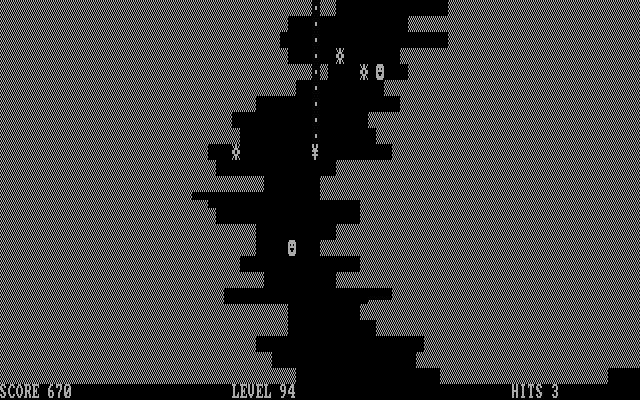
The core gameplay loop centers on risk management versus point accumulation. Scraping against the stone edges of the pit will knock points off your health pool rather than killing you outright. You start each run with ten hit points, giving you a small safety net for minor steering errors against the cavern walls.
To keep you alive, the game features an automatic repair system. Every three thousand points you earn as you maneuver deeper into the tunnel, your craft receives five additional hit points. Along the way, you can pick up floating stars scattered in the depths to snag an immediate bonus of two hundred points, encouraging you to veer away from safe center lines into tighter spaces.
The real danger comes from the disembodied faces and floating boulders drifting in the shaft. While hitting a wall merely damages your hull, touching one of these creepy obstacles results in immediate destruction. It does not matter how many extra lives or hull points you have accumulated on your descent. One touch and you are history, ending your attempt instantly.
Why modern processors break the descent
As a classic action game from the early MS-DOS era, the binary file relies entirely on system clock timing. On period hardware, the smooth scrolling of text characters offered a manageable twitch response. Running the game on a modern CPU without throttling causes the tunnel to scroll at unplayable speeds, instantly slamming your ship into the first boulder.
To get a fair experience in modern emulation environments like DOSBox, you have to choke the CPU emulation speed down aggressively. Slowing the machine down to somewhere between 150 and 240 cycles, or applying a 96 percent slowdown, restores the intended momentum. At that correct pacing, the audio delivers crisp, rudimentary sound effects through the standard PC speaker setup.
Even with the cycle count properly set, navigating narrow sections forces you into tight maneuvers. The random generator occasionally places hazards in ways that require sudden, precise taps of the thrust keys to squeeze through safely without losing half your hull.
A harsh reflex test from the freeware era
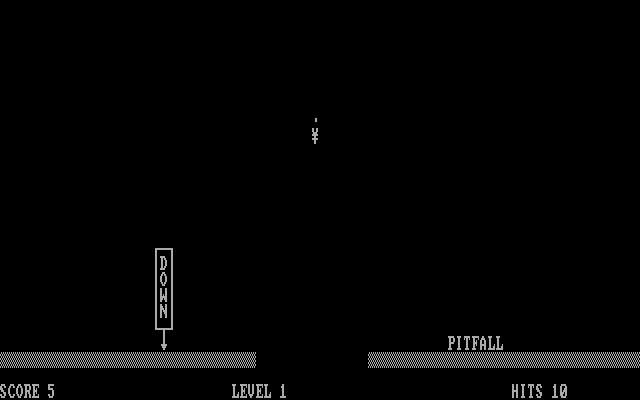
Created by an unknown designer and distributed as freeware, the release strips away all excess window dressing to focus entirely on score chasing. It presents no bosses, elaborate level transitions, or weapon upgrades. The challenge is entirely about how long your reflexes can hold out against a endless vertical wall of text characters.
Early computer gaming review outlets noted that the visual presentation is purely functional ASCII, but acknowledged that the game delivered hours of challenging action despite its tiny file footprint. The primary criticism then, as now, stems from how brutal the random placement can be. Because hazard patterns generate on the fly, avoiding every lethal object is a massive hurdle that regularly ends promising runs without warning.
There are no checkpoints or second chances here. Once your craft explodes against a floating hazard, your run ends on the spot and you are forced to start over from the top of the shaft. That strict permadeath rule keeps tension high from the moment you hit the key to drop into the tunnel.
Drop straight into the pit without tweaking cycle counts
This text-mode survival game still tests raw spatial awareness and quick finger work. Strip away modern graphics and high-definition audio, and you are left with pure timing, tight corridors, and the constant threat of instant failure. Early PC developers built real tension using basic terminal characters and simple keyboard movement.
If you want to experience this early piece of software history, you can play Pitfall free in your browser right now with no setup needed. The emulation handles the proper cycle throttling automatically, so you can focus entirely on dodging boulders and chasing high scores down the endless shaft.
How Pitfall is played — the keys the game listens to, grouped by what they do.
- Movement
Highlighted keys are mapped — hover or tap one to see what it does.
Control map is incomplete as menu, pause, and quit keys were not documented in the available secondary sources.
Players' controls
Touch and gamepad controls
The on-screen keyboard and gamepad mapping the browser player uses on a phone, a tablet or a controller, as opposed to the real keys above. $PRO members make their own in the player and share them here; anyone can pick one to play with.
Make your own touch controlsPRO
- 1Open the editorSign in below, then pick what to make. The game starts with the editor open over it.
- 2Place your keysAdd keys and drag them where your thumbs rest, or map a controller's buttons. Test plays the game with them; Save keeps them, and you play with them from then on.
- 3Share themShare them right after saving in the game, or name and share them here. Players vote, and the best become this game's controls for everyone.
Go PROSee how it worksSign in+20 XP for sharing · +50 XP if yours become the game's own
- The game's own controlsKeyboardGamepadWhat every player starts with.In use
2 screenshots
From the archive
No reviews yet
Tell the community what you think of Pitfall. Reviews are public and tied to your username.
No archived manuals for Pitfall yet
No manuals archived for this title yet. Sign in to upload the first scan.
Cheat codes, console commands and memory pokes for Pitfall — each one verified and attributed.
Sign in to submitNo cheats yet for this title
Know a working cheat, poke or trainer? Add it with the button above. Moderators check every entry before it goes live.
No archived soundtrack for Pitfall yet
No soundtrack archived for this title yet. Sign in to upload the first rip.
No save states for Pitfall yet
No save states for this title yet. Sign in to share one.
Discussions
Sign in to post- Threads0
- Total posts0
- Online now6
Community · Pitfall
Who's contributing, and what's new
- Reviews0
- Threads0
- Uploadsapproved0
- Contributors0
Recent activity
Nothing here yet
Reviews, discussion threads and approved uploads appear here as members add them.