


Pitfall II: Lost Caverns
aka David Crane's Pitfall II: Lost Caverns
Rate this game
- Played
- A lot
Pitfall II: Lost Caverns takes the linear jungle survival of the 1982 original and buries it underground, creating a massive, interconnected labyrinth that completely rewrites how platforming games manage failure.
Ditching the timer for a massive underground maze
Instead of racing left-to-right across twenty minutes of surface screens before a single clock runs out, you drop Pitfall Harry straight down a shaft into the sprawling depths of the Andes. The objective sounds simple enough on paper: locate your lost niece Rhonda, her cowardly pet mountain lion Quickclaw, and the Raj Diamond. Getting to them requires mapping out a subterranean system that stretches across twenty-seven vertical levels and dozens of horizontal rooms, making it an early pioneer for what would later be called the Metroidvania style.
The screen transitions mix horizontal flip-screen navigation with vertical scrolling as Harry descends deep into dark caverns. Gravity does half your work on the way down, but climbing back up turns every ladder into a tactical nightmare. You spend the first few minutes discovering that Harry has no gun, no whip, and no direct attack of any kind. Survival depends entirely on timing your movements around strict enemy patrol routes.
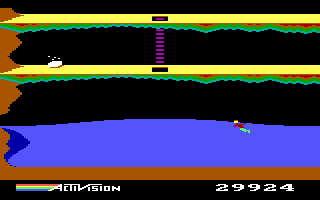
What made Pitfall II: Lost Caverns so startling back in 1984 was its total rejection of traditional lives and extra-life pickups. Creator David Crane designed a system where touching an enemy never causes a game over screen. Instead, touching a poison arrow frog, electric eel, scorpion, or condor immediately docks a chunk of your hard-earned score and floats Harry backward through the cavern air, dropping him off at the last red-cross checkpoint banner you touched. You lose progress and points, but you never hit a hard wall that kicks you back to the DOS prompt.
Stiff jumps and lethal ladders in Pitfall II: Lost Caverns
For all its generous checkpoint design, the physical act of moving Harry around can feel maddeningly rigid on an IBM PC. Jump controls locked Harry into fixed arc trajectories from the instant his shoes left the dirt. Once you press the jump button, you have zero mid-air influence over his direction or speed. If you misjudge a leap over a scorpion near a ladder, Harry sails helplessly into the sting, taking a point penalty before floating back down three screens to the previous cross.
The local wildlife is positioned with deliberate cruelty around those same ladders. Scorpions patrol the foot of vital vertical climbs, while bats fly back and forth through narrow rock gaps, directly tracking Harry's height on the rungs. One specific nuisance that caught almost every player off guard was the cavern rat. Approaching this grey rodent from the front is completely useless because it simply shoves Harry backward down the ledge. To clear the path, you have to navigate through secondary shafts, drop down behind the rat, and bypass it from its blind side.
- Poison Arrow Frogs: Hop unpredictably along flat ledges, requiring high leaps at the peak of their bounce.
- Electric Eels: Swim through underground rivers, blocking long underwater treks.
- Cave Rats: Impasse hazards that force players to find alternative routes to approach from behind.
- Condors & Bats: Flying obstacles that lock onto ladder pathways and alter their vertical rhythm.
Audio on early PC setups had to reproduce the work of Crane's custom DPC sound hardware through the humble PC speaker or basic expansion boards. While home console platforms enjoyed four-channel synthesized music, early computer monitors sputtered out the persistent, driving main tune in stark single-tone beeps. Even with limited hardware, that upbeat melody kept players moving through endless cycles of floating backward and retrying tricky jumps.
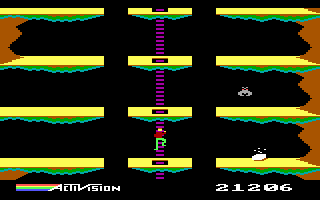
Why the cavern design holds up for modern players
When Activision, Inc. released the MS-DOS port, computer owners received a title that valued exploration over raw reflex tests. The game rewards spatial mapping over twitch reactions. Finding high-value gold bars tucked into dead-end caverns offers real satisfaction, especially when securing a high score demands completing the search with as few hazard penalties as possible.
Unlike many action games from 1984 that relied on brutal arcade coin-op mechanics to lengthen playtime, this trip through the Andes treats spatial knowledge as the ultimate goal. The satisfaction comes from memorizing the cavern layout, finding the shortest return loops, and rescuing Rhonda and Quickclaw without losing ten thousand points to floating bat hitboxes along the way.
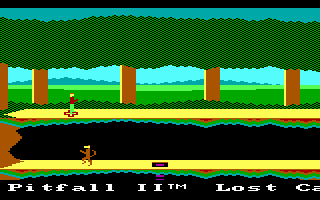
Jump straight into the subterranean search today
Its interconnected map structure and forgiving check-in loop give the game a flow most platformers of its year lacked. The jump physics require some getting used to, but working your way through the subterranean caverns is a great puzzle if you want to see how early computer titles handled open exploration.
You can play Pitfall II: Lost Caverns online, free in your browser right now with no setup needed. Fire up the prompt, drop straight down that first cavern shaft, and see if you can bypass the cave rat on your way to the Raj Diamond without losing your entire score to the local frogs.
How Pitfall II: Lost Caverns is played — the keys the game listens to, grouped by what they do.
- Movement
- Action
- Interface
Highlighted keys are mapped — hover or tap one to see what it does.
Players' controls
Touch and gamepad controls
The on-screen keyboard and gamepad mapping the browser player uses on a phone, a tablet or a controller, as opposed to the real keys above. $PRO members make their own in the player and share them here; anyone can pick one to play with.
Make your own touch controlsPRO
- 1Open the editorSign in below, then pick what to make. The game starts with the editor open over it.
- 2Place your keysAdd keys and drag them where your thumbs rest, or map a controller's buttons. Test plays the game with them; Save keeps them, and you play with them from then on.
- 3Share themShare them right after saving in the game, or name and share them here. Players vote, and the best become this game's controls for everyone.
Go PROSee how it worksSign in+20 XP for sharing · +50 XP if yours become the game's own
- The game's own controlsKeyboardGamepadWhat every player starts with.In use
3 screenshots
From the archive
No gameplay video yet
No gameplay video for Pitfall II: Lost Caverns yet. Sign in to add one.
No reviews yet
Tell the community what you think of Pitfall II: Lost Caverns. Reviews are public and tied to your username.
No archived manuals for Pitfall II: Lost Caverns yet
No manuals archived for this title yet. Sign in to upload the first scan.
Cheat codes, console commands and memory pokes for Pitfall II: Lost Caverns — each one verified and attributed.
Sign in to submitNo cheats yet for this title
Know a working cheat, poke or trainer? Add it with the button above. Moderators check every entry before it goes live.
No archived soundtrack for Pitfall II: Lost Caverns yet
No soundtrack archived for this title yet. Sign in to upload the first rip.
No save states for Pitfall II: Lost Caverns yet
No save states for this title yet. Sign in to share one.
Discussions
Sign in to post- Threads0
- Total posts0
- Online now6
Community · Pitfall II: Lost Caverns
Who's contributing, and what's new
- Reviews0
- Threads0
- Uploadsapproved0
- Contributors0
Recent activity
Nothing here yet
Reviews, discussion threads and approved uploads appear here as members add them.