
Starting out in Starflight means standing on the bridge of a frail ship with barely enough fuel to reach the next sun, tasked with uncovering why stars across the galaxy are suddenly exploding.
Before you ever touch the thrusters, you are forced to sit in Starport and manage your budget down to the last credit. You hire a crew across several species, train their attributes, and buy essential equipment. You load up on Endurium for fuel, bolt on basic armor, install a terrain lander, and install shield generators. Leaving dock without enough fuel means drifting into deep space to die, turning your first hours into a tense exercise in resource management.
Once you clear the home port of planet Arth, the screen opens up to a vast top-down grid of solar systems. The game hands you total freedom right away, but it punishes recklessness without mercy. Early on, space travel feels like an extraordinarily expensive hobby where every jump consumes precious reserves. If you burn through your fuel while exploring distant star clusters, there is no rescue ship coming to pull you out.
The sheer scope of the game came down to brilliant programming by Binary Systems. Instead of manually building hundreds of planets, programmers Tim C. Lee and Dave Boulton designed a fractal planet generator that used seed numbers to generate surface terrain and lifeforms on the fly. This system allowed the developers to fit over 800 fully explorable planets into compact memory. It gave the 1986 title a scale that few contemporary games could dream of matching.
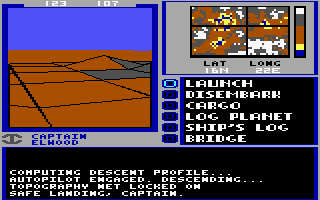
Landing on a planet switches the view to a top-down vehicle driving across procedural terrain. Your job is simple: gather minerals, record biological data, and look for ancient alien secrets. You drive the Terrain Vehicle through mountain ranges and plains, scooping up valuable ores while keeping an eye on your vehicle's energy. Bringing those minerals back to base is how you fund critical ship upgrades and keep your expedition alive.
Space is far from empty, and meeting another ship requires actual diplomacy rather than just firing lasers. You encounter distinctive alien races like the plant-like Elowan, the commercial Thrynn, the insectoid Velox, and the aggressive Uhlek. Setting your crew's posture to friendly, hostile, or neutral shapes how these factions respond to you. Saying the wrong thing to a proud Velox commander will instantly trigger a fight you might not be equipped to win.
Combat plays out in real time, requiring you to balance shield power, missile stocks, and laser fire while maneuvering your vessel. But the real terror of combat comes from the strict ironman nature of the save system. Starflight saves your game state directly to the disk when major events happen, meaning a destroyed ship or a fatal navigational error is permanent. Losing a fully upgraded ship and a veteran crew after twenty hours of work is a brutal lesson that modern games rarely dare to teach.
The physical box also included a code wheel for copy protection. If you failed to enter the matching password off the cardboard wheel when leaving dock, the Interstel Corporate Police would intercept your ship in space and instantly blow you out of the sky. Combined with supplementary manual texts that could feel mood-killingly goofy compared to the serious game world, it was a wild mix of strict copy protection and sci-fi lore.
You will hit a steep learning curve at first, but this role-playing adventure set the pattern for later games like Star Control II and Mass Effect. Picking up a set of mysterious stellar coordinates, flying into unknown space, and discovering a forgotten relic on a distant world still works. It demands patience and careful planning, but few space games give you this much genuine ownership over your journey.
You can play Starflight free in your browser right on this page, running directly in the original MS-DOS version with no setup required. Before you take off from Starport, make sure to save enough credits for a full tank of Endurium fuel and a Terrain Vehicle, or your first interstellar trip will end before it even starts.
Starting out in Starflight means standing on the bridge of a frail ship with barely enough fuel to reach the next sun, tasked with uncovering why stars across the galaxy are suddenly exploding.
Before you ever touch the thrusters, you are forced to sit in Starport and manage your budget down to the last credit. You hire a crew across several species, train their attributes, and buy essential equipment. You load up on Endurium for fuel, bolt on basic armor, install a terrain lander, and install shield generators. Leaving dock without enough fuel means drifting into deep space to die, turning your first hours into a tense exercise in resource management.
Once you clear the home port of planet Arth, the screen opens up to a vast top-down grid of solar systems. The game hands you total freedom right away, but it punishes recklessness without mercy. Early on, space travel feels like an extraordinarily expensive hobby where every jump consumes precious reserves. If you burn through your fuel while exploring distant star clusters, there is no rescue ship coming to pull you out.

The sheer scope of the game came down to brilliant programming by Binary Systems. Instead of manually building hundreds of planets, programmers Tim C. Lee and Dave Boulton designed a fractal planet generator that used seed numbers to generate surface terrain and lifeforms on the fly. This system allowed the developers to fit over 800 fully explorable planets into compact memory. It gave the 1986 title a scale that few contemporary games could dream of matching.
Landing on a planet switches the view to a top-down vehicle driving across procedural terrain. Your job is simple: gather minerals, record biological data, and look for ancient alien secrets. You drive the Terrain Vehicle through mountain ranges and plains, scooping up valuable ores while keeping an eye on your vehicle's energy. Bringing those minerals back to base is how you fund critical ship upgrades and keep your expedition alive.
Space is far from empty, and meeting another ship requires actual diplomacy rather than just firing lasers. You encounter distinctive alien races like the plant-like Elowan, the commercial Thrynn, the insectoid Velox, and the aggressive Uhlek. Setting your crew's posture to friendly, hostile, or neutral shapes how these factions respond to you. Saying the wrong thing to a proud Velox commander will instantly trigger a fight you might not be equipped to win.

Combat plays out in real time, requiring you to balance shield power, missile stocks, and laser fire while maneuvering your vessel. But the real terror of combat comes from the strict ironman nature of the save system. Starflight saves your game state directly to the disk when major events happen, meaning a destroyed ship or a fatal navigational error is permanent. Losing a fully upgraded ship and a veteran crew after twenty hours of work is a brutal lesson that modern games rarely dare to teach.
The physical box also included a code wheel for copy protection. If you failed to enter the matching password off the cardboard wheel when leaving dock, the Interstel Corporate Police would intercept your ship in space and instantly blow you out of the sky. Combined with supplementary manual texts that could feel mood-killingly goofy compared to the serious game world, it was a wild mix of strict copy protection and sci-fi lore.
You will hit a steep learning curve at first, but this role-playing adventure set the pattern for later games like Star Control II and Mass Effect. Picking up a set of mysterious stellar coordinates, flying into unknown space, and discovering a forgotten relic on a distant world still works. It demands patience and careful planning, but few space games give you this much genuine ownership over your journey.
You can play Starflight free in your browser right on this page, running directly in the original MS-DOS version with no setup required. Before you take off from Starport, make sure to save enough credits for a full tank of Endurium fuel and a Terrain Vehicle, or your first interstellar trip will end before it even starts.
How Starflight is played — the keys the game listens to, grouped by what they do.
Highlighted keys are mapped — hover or tap one to see what it does.
Movement controls apply to crosshair targeting, ship steering, and terrain vehicle maneuvering. System menus pause actions in real-time play.
The on-screen keyboard and gamepad mapping the browser player uses on a phone, a tablet or a controller, as opposed to the real keys above. $PRO members make their own in the player and share them here; anyone can pick one to play with.
Cheat codes, console commands and memory pokes for Starflight — each one verified and attributed.
Sign in to submitHow Starflight is played — the keys the game listens to, grouped by what they do.
Highlighted keys are mapped — hover or tap one to see what it does.
Movement controls apply to crosshair targeting, ship steering, and terrain vehicle maneuvering. System menus pause actions in real-time play.
The on-screen keyboard and gamepad mapping the browser player uses on a phone, a tablet or a controller, as opposed to the real keys above. $PRO members make their own in the player and share them here; anyone can pick one to play with.
Cheat codes, console commands and memory pokes for Starflight — each one verified and attributed.
Sign in to submit