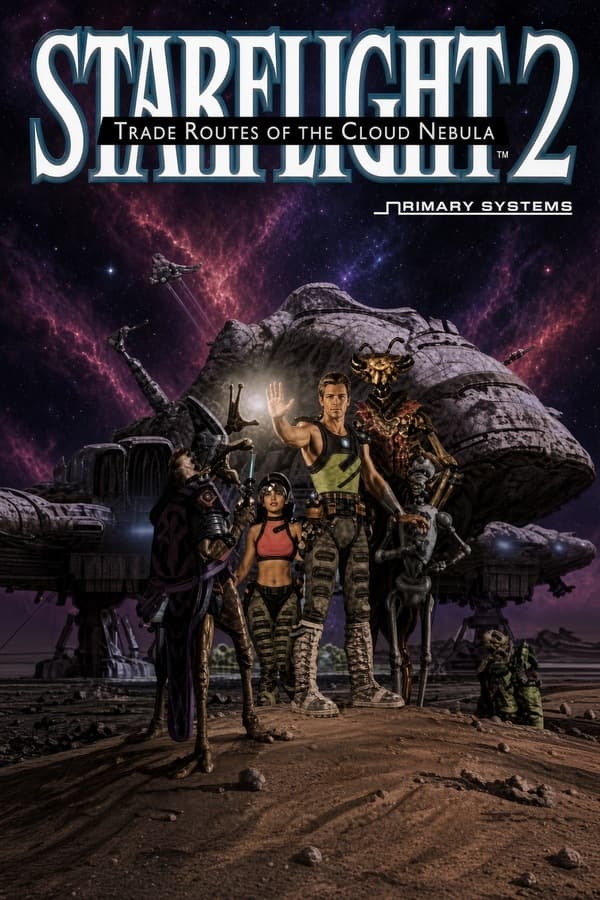
aka Starflight II · Starflight II: Trade Routes of the Cloud Nebula
In Starflight 2: Trade Routes of the Cloud Nebula, you are handed a starship crew, a vast star map, and an immediate crisis: the once-cowardly Spemin have acquired advanced technology across a wormhole, and humanity needs you to go barter, scan, and shoot your way to answers.
The core engine of Starflight 2: Trade Routes of the Cloud Nebula builds directly on what Binary Systems established in the original space simulation. Instead of taking all your harvested raw materials back to a central Interstel base, you now drop into planetary trading posts across the Cloud Nebula to haggle with local alien species. Fuel management still exerts brutal pressure, meaning a bad navigation vector or an extra jump through a flux can leave your vessel stranded in deep space long before you reach a friendly port.
Your journey requires navigating 150 solar systems and checking out more than 500 individual planets. As captain, your daily routine involves assigning roles to your crew, including a scientist, doctor, engineer, and navigator, while constantly balancing training costs against hardware upgrades. You deploy Mineral Drones to strip surfaces for quick cash, use System Scanners to evaluate targets, and rely on Psychic Probes to cut through diplomatic posturing when negotiating with weird extraterrestrial traders.
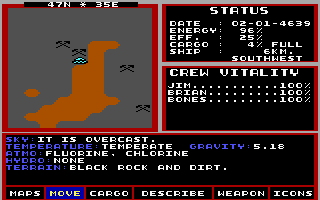
Exploration relies on a distinct shift in perspective. While interstellar travel and ship operations use menu-driven bridge terminals, landing on a planet drops you into a top-down view where you drive an armored rover around the terrain. Here, you collect local flora, hunt for mineral deposits, and search for clues left behind in ancient ruins to solve the main mystery.
combat and defense rely heavily on ship setup. If peaceful trade fails against aggressive alien fleets like the Spemin or the hostile Uhlek, you rely on specialized gear:
The scope of this 1989 release was massive, but it brought along severe design quirks. Computer Gaming World named it Role-Playing Game of the Year in 1990, praising its open structure while rightly calling out its simplistic ship combat and clunky menus. A major irritation is the conversation playback log: once you start reading back a log of dialogue, the game offers no exit button, forcing you to scroll through every single line line-by-line before returning to bridge controls.
The save system on the original floppy releases was equally unforgiving. The game featured a single save slot, and if your party died or if you shut off your PC without using the strict exit routine, your save file was destroyed outright. Physical releases from publisher Electronic Arts, Inc. also included strict copy protection in the form of a physical decoder and a plastic tool called the Humna Humna map device, which required players to count specific colored stars on a printed paper map to confirm coordinates.
Lead designer Greg Johnson spent years working through the heavy universe rules, extensive alien language branches, and deep inventory tables of the first two games. The sheer volume of technical management and serious sci-fi worldbuilding left him exhausted. After wrapping up development with developer Binary Systems, Johnson deliberately moved away from complex sci-fi systems to design something intentionally silly and lighthearted: the Genesis classic ToeJam & Earl.
That shift makes total sense when you spend ten hours managing trade ratios with strange alien species in the MS-DOS version of the game. For players who enjoy rich open-world sandbox structure, deep crew management, and true galaxy exploration, it is still a high point among classic role-playing (RPG) games.
The combat remains simple and the dialogue log bug still tests your patience, but the sense of venturing into an unknown sector to negotiate with strange aliens holds up surprisingly well. You can play Starflight 2: Trade Routes of the Cloud Nebula free in your browser right now, with no setup required. Jump into the captain's chair, keep a close eye on your fuel reserves, and make sure you save your game safely before entering Uhlek space.
In Starflight 2: Trade Routes of the Cloud Nebula, you are handed a starship crew, a vast star map, and an immediate crisis: the once-cowardly Spemin have acquired advanced technology across a wormhole, and humanity needs you to go barter, scan, and shoot your way to answers.
The core engine of Starflight 2: Trade Routes of the Cloud Nebula builds directly on what Binary Systems established in the original space simulation. Instead of taking all your harvested raw materials back to a central Interstel base, you now drop into planetary trading posts across the Cloud Nebula to haggle with local alien species. Fuel management still exerts brutal pressure, meaning a bad navigation vector or an extra jump through a flux can leave your vessel stranded in deep space long before you reach a friendly port.
Your journey requires navigating 150 solar systems and checking out more than 500 individual planets. As captain, your daily routine involves assigning roles to your crew, including a scientist, doctor, engineer, and navigator, while constantly balancing training costs against hardware upgrades. You deploy Mineral Drones to strip surfaces for quick cash, use System Scanners to evaluate targets, and rely on Psychic Probes to cut through diplomatic posturing when negotiating with weird extraterrestrial traders.

Exploration relies on a distinct shift in perspective. While interstellar travel and ship operations use menu-driven bridge terminals, landing on a planet drops you into a top-down view where you drive an armored rover around the terrain. Here, you collect local flora, hunt for mineral deposits, and search for clues left behind in ancient ruins to solve the main mystery.
combat and defense rely heavily on ship setup. If peaceful trade fails against aggressive alien fleets like the Spemin or the hostile Uhlek, you rely on specialized gear:
The scope of this 1989 release was massive, but it brought along severe design quirks. Computer Gaming World named it Role-Playing Game of the Year in 1990, praising its open structure while rightly calling out its simplistic ship combat and clunky menus. A major irritation is the conversation playback log: once you start reading back a log of dialogue, the game offers no exit button, forcing you to scroll through every single line line-by-line before returning to bridge controls.
The save system on the original floppy releases was equally unforgiving. The game featured a single save slot, and if your party died or if you shut off your PC without using the strict exit routine, your save file was destroyed outright. Physical releases from publisher Electronic Arts, Inc. also included strict copy protection in the form of a physical decoder and a plastic tool called the Humna Humna map device, which required players to count specific colored stars on a printed paper map to confirm coordinates.

Lead designer Greg Johnson spent years working through the heavy universe rules, extensive alien language branches, and deep inventory tables of the first two games. The sheer volume of technical management and serious sci-fi worldbuilding left him exhausted. After wrapping up development with developer Binary Systems, Johnson deliberately moved away from complex sci-fi systems to design something intentionally silly and lighthearted: the Genesis classic ToeJam & Earl.
That shift makes total sense when you spend ten hours managing trade ratios with strange alien species in the MS-DOS version of the game. For players who enjoy rich open-world sandbox structure, deep crew management, and true galaxy exploration, it is still a high point among classic role-playing (RPG) games.
The combat remains simple and the dialogue log bug still tests your patience, but the sense of venturing into an unknown sector to negotiate with strange aliens holds up surprisingly well. You can play Starflight 2: Trade Routes of the Cloud Nebula free in your browser right now, with no setup required. Jump into the captain's chair, keep a close eye on your fuel reserves, and make sure you save your game safely before entering Uhlek space.
How Starflight 2: Trade Routes of the Cloud Nebula is played — the keys the game listens to, grouped by what they do.
Highlighted keys are mapped — hover or tap one to see what it does.
Reference materials for Starflight 2 on MS-DOS are incomplete in the provided notes, only supporting F10 explicitly. Mouse, joystick, and text input are also supported by the game mechanics.
The on-screen keyboard and gamepad mapping the browser player uses on a phone, a tablet or a controller, as opposed to the real keys above. $PRO members make their own in the player and share them here; anyone can pick one to play with.
Cheat codes, console commands and memory pokes for Starflight 2: Trade Routes of the Cloud Nebula — each one verified and attributed.
Sign in to submitHow Starflight 2: Trade Routes of the Cloud Nebula is played — the keys the game listens to, grouped by what they do.
Highlighted keys are mapped — hover or tap one to see what it does.
Reference materials for Starflight 2 on MS-DOS are incomplete in the provided notes, only supporting F10 explicitly. Mouse, joystick, and text input are also supported by the game mechanics.
The on-screen keyboard and gamepad mapping the browser player uses on a phone, a tablet or a controller, as opposed to the real keys above. $PRO members make their own in the player and share them here; anyone can pick one to play with.
Cheat codes, console commands and memory pokes for Starflight 2: Trade Routes of the Cloud Nebula — each one verified and attributed.
Sign in to submit