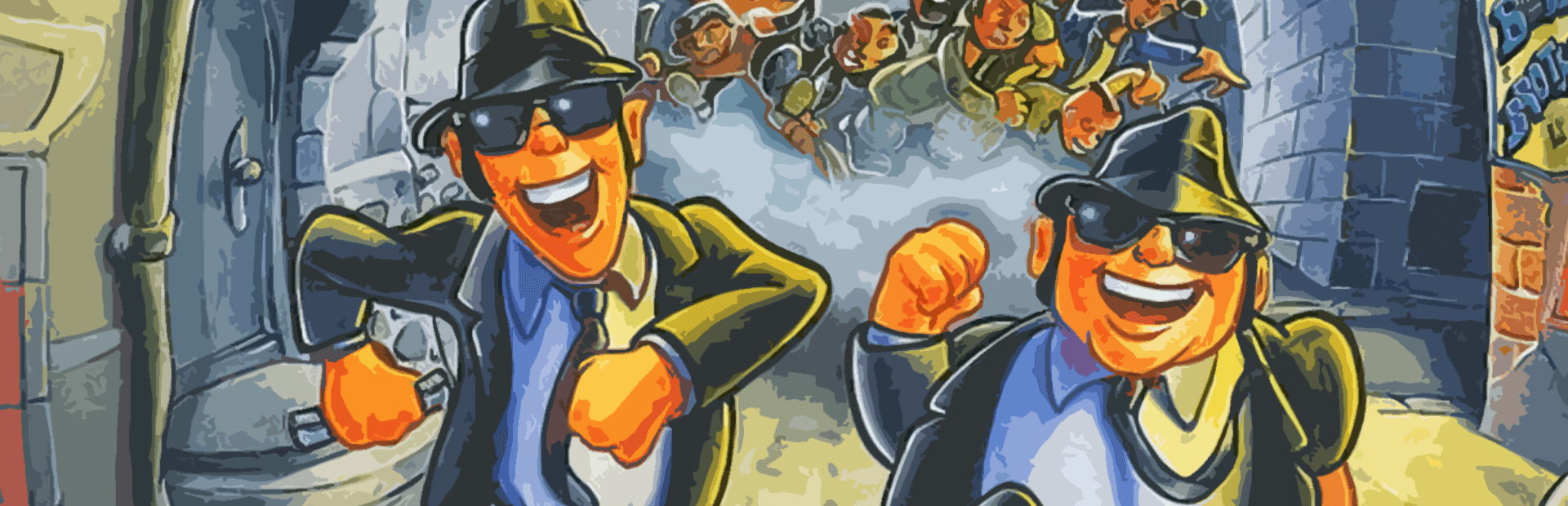
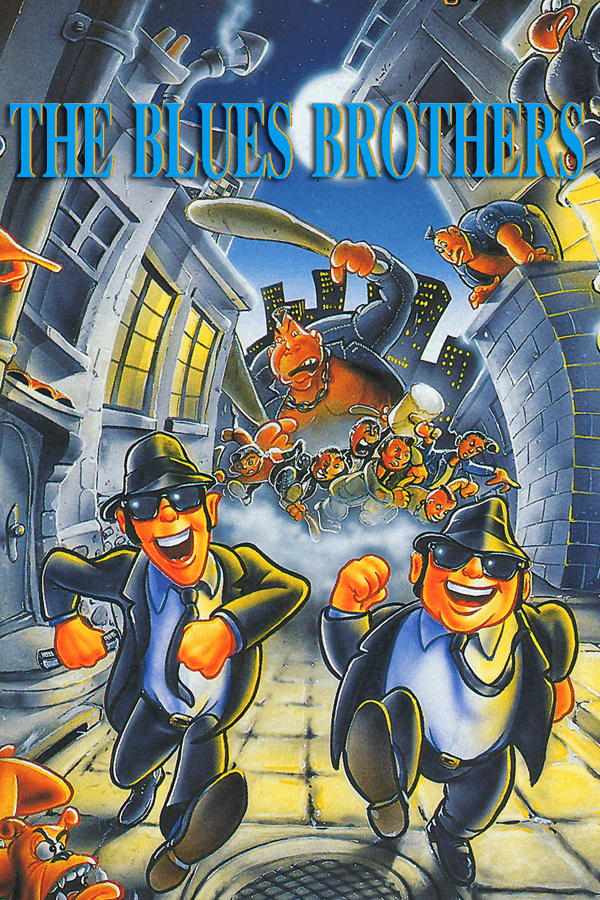

The Blues Brothers
aka HaAhim Bluz
Rate this game
- Played
- Often
Titus Software took a rhythm-and-blues movie license and turned it into a surprisingly tight platformer where you throw heavy crates at police officers.
The Blues Brothers turns a movie about music into a hunt for missing gear
You might expect a game based on Jake and Elwood Blues to focus on car chases, high-speed evasions, or rhythm-based mechanics. Instead, developer Titus France SA took the licensed characters and dropped them straight into a classic side-scrolling action layout. To get to the final concert hall performance, you have to guide either Jake or Elwood through five sprawling levels to recover five essential concert items: a microphone, a guitar, an amplifier, a poster, and a stage pass.
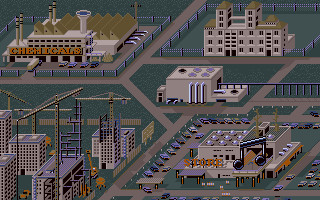
The core gameplay relies on environmental navigation and throwing objects. You do not shoot pistols or swing weapons; instead, your primary line of defense is picking up heavy crates off the floor and tossing them at oncoming enemies. You can also stack these boxes or jump onto them to reach high platforms and hidden alcoves tucked away off the main route. It is a straightforward design that places heavy emphasis on momentum and vertical maneuvering.
Recycling mechanics from Titus the Fox
Anyone who spent time with PC games in 1991 will immediately spot where this engine came from. Titus built this title using the same underlying mechanics, physics, and crate-throwing systems seen in Titus the Fox. The characters feel light, speed builds up quickly, and jumping requires precision. Elwood is noticeably snappier on his feet, while Jake feels a bit bulkier as he lands from high falls.
The sound design holds a special spot for DOS players who grew up with standard hardware. While a basic PC speaker buzzes through flat renditions of the tunes, hooking the game up to an AdLib card or a Tandy 3-Channel setup turns the soundtrack into a fantastic FM synth rendition of the classic Peter Gunn theme. Hearing those FM synth horn lines kick in while ducking past angry riot police gives the game an unmistakable late-80s early-90s PC audio flavor, organized in part by composer Dimitris Yerasimos.
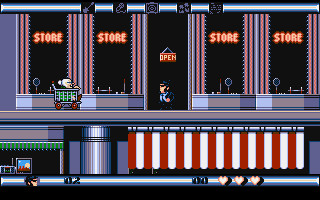
Tricky jumps and chaotic two-player co-op
The stage design ramps up the difficulty quickly. You start in manageable locations like "Stairway to Heaven" and "Wear-House", but later levels like "Underworld" and "Demolition Experts" require precise jumps over spikes, moving elevators, and sewer crocodiles. Guard dogs, prison wardens, flying birds, and waiters tossing frozen peas respawn constantly. Picking up scattered vinyl records restores your health, and grabbing an umbrella lets you float down safely from high drops.
If you play with a friend in two-player mode, the game becomes entertaining but absolute chaos. The engine does not split the screen, meaning the scrolling camera anchors itself to one player. If your partner gets left behind, they get yanked off-screen, often landing directly into a hazard or a respawning riot officer. It requires constant coordination, though typing the level-skip cheat code HOULQ at the character choice screen lets you skip straight to your favorite stages if a particular level proves too frustrating.
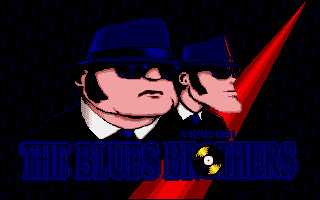
Why you should play The Blues Brothers free in your browser today
Titus gave us a fast, tough European platformer with sharp AdLib music and crisp VGA sprites. The split-screen camera in two-player mode forces both players to sync their movement, and a missed jump late in a stage will cost you a life instantly, but learning to hurl crates into a crowd of riot guards keeps you coming back for another run.
You can play The Blues Brothers online for free right here in your browser, with no setup required. Load up the first stage, grab a crate, and turn up the sound to hear that AdLib synth beat carry you straight to the concert stage.
How The Blues Brothers is played — the keys the game listens to, grouped by what they do.
- Movement
- Action
- Interface
Highlighted keys are mapped — hover or tap one to see what it does.
Players' controls
Touch and gamepad controls
The on-screen keyboard and gamepad mapping the browser player uses on a phone, a tablet or a controller, as opposed to the real keys above. $PRO members make their own in the player and share them here; anyone can pick one to play with.
Make your own touch controlsPRO
- 1Open the editorSign in below, then pick what to make. The game starts with the editor open over it.
- 2Place your keysAdd keys and drag them where your thumbs rest, or map a controller's buttons. Test plays the game with them; Save keeps them, and you play with them from then on.
- 3Share themShare them right after saving in the game, or name and share them here. Players vote, and the best become this game's controls for everyone.
Go PROSee how it worksSign in+20 XP for sharing · +50 XP if yours become the game's own
- The game's own controlsKeyboardGamepadWhat every player starts with.In use
3 screenshots
From the archive
No gameplay video yet
No gameplay video for The Blues Brothers yet. Sign in to add one.
No reviews yet
Tell the community what you think of The Blues Brothers. Reviews are public and tied to your username.
No archived manuals for The Blues Brothers yet
No manuals archived for this title yet. Sign in to upload the first scan.
Cheat codes, console commands and memory pokes for The Blues Brothers — each one verified and attributed.
Sign in to submitNo cheats yet for this title
Know a working cheat, poke or trainer? Add it with the button above. Moderators check every entry before it goes live.
No archived soundtrack for The Blues Brothers yet
No soundtrack archived for this title yet. Sign in to upload the first rip.
No save states for The Blues Brothers yet
No save states for this title yet. Sign in to share one.
Discussions
Sign in to post- Threads0
- Total posts0
- Online now6
Community · The Blues Brothers
Who's contributing, and what's new
- Reviews0
- Threads0
- Uploadsapproved0
- Contributors0
Recent activity
Nothing here yet
Reviews, discussion threads and approved uploads appear here as members add them.