
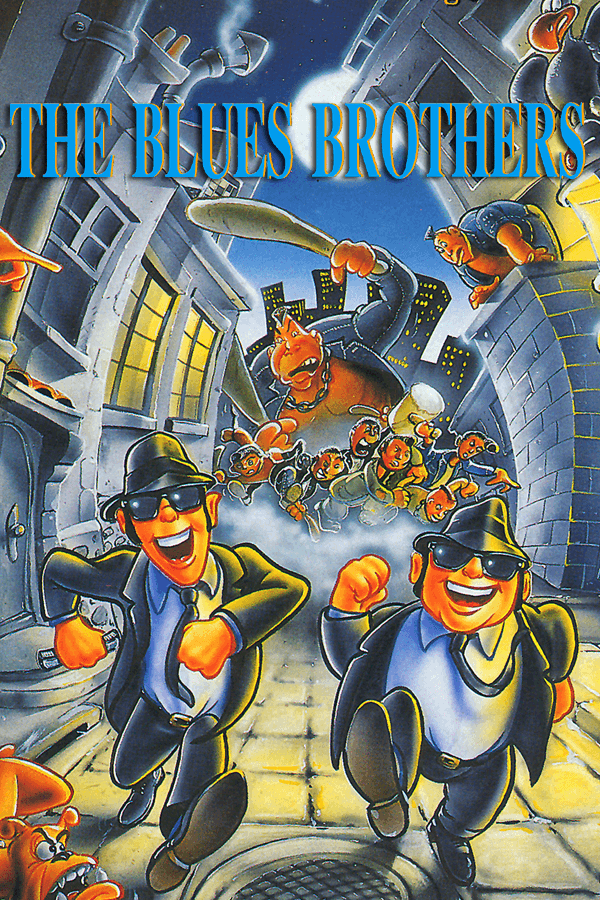

The Blues Brothers: Jukebox Adventure
aka Blues Brothers: Jukebox Adventure · The Blues Brothers · The Blues Brothers 2 · ブルースブラザース
Rate this game
- Played
- Often
Playing The Blues Brothers: Jukebox Adventure on MS-DOS means chucking vinyl records at giant snails and crazy lawnmowers, all set to PC speaker and Sound Blaster chip arrangements of classic R&B tunes.
When movie tie-ins traded lore for absurd platforming
Titus Software did not bother sticking to the script for this 1993 sequel. Instead of dodging the Chicago Police Department or hunting down gig money, Jake and Elwood Blues end up trapped inside a magical jukebox. Your job across roughly thirty side-scrolling stages is simple: run to the right, dodge hazards, and reach the exit jukebox to clear the stage.
The developer swapped street chases for surreal enemies. You spend your time dodging bodybuilders, bouncing over giant snails, and weaving around runaway lawnmowers. To defend yourself, you pick up collectible vinyl LPs and toss them as limited projectiles. If you run out of records, your only choice is to jump over enemies or walk around them.
The power-up system is where the design gets bizarre. Picking up a cake transforms you into a giant "Super Blues Brother" capable of plowing through obstacles. You can also pick up eggs dropped by dodo-like birds and balance them on your hat for points. Mini jukeboxes give short bursts of invincibility, which helps when the screen fills up with flying hazards.
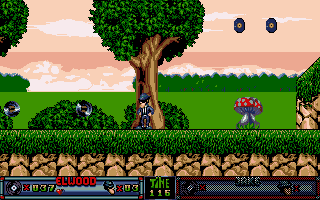
Two-player simultaneous co-op is easily the best feature in the game. If your partner cannot clear a wide gap, you can pick up their character and throw them straight across the pit. It adds a layer of coordination that turns an otherwise basic walk from left to right into something genuinely fun with a friend.
Where basic controls meet low difficulty
If you come to this expecting the tight physics of European hardware staples, the movement feeing will disappoint you. The brothers have a basic jump and a walk, but no slide, crouch-attack, or secondary physical moves. When you run out of vinyl records, you are left completely defenseless beyond basic dodge jumps.
The difficulty curve sits on the opposite end of most early nineties action games. The levels are short, enemy patterns are simple to memorize, and extra health hearts appear frequently. Arcade veterans usually breeze through the game in a single afternoon, as the hazards rarely demand precise timing.
The PC conversion also suffers from technical quirks. While the Amiga build was target-designed for fluid 50fps scrolling, the MS-DOS port suffers from jerky, uneven screen updating in standard VGA mode. The background stutters noticeably when you run at full speed, which can obscure small hazards until you drop directly onto them.
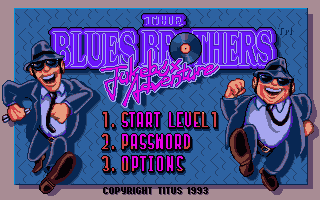
If you want to skip the casual pacing, you can type WALLOO right on the character selection screen. Doing so shifts the menu background color and gives you a level select prompt, letting you jump straight to the later stages where hazards stack up a bit faster.
The DOS conversion hits a different beat than its console cousins
Published in 1993 by Titus France SA and programmed for PC by Michaël Knaepen, the game arrived alongside Super Nintendo and Game Boy editions. The console releases were stripped down in places, but the MS-DOS port kept the core level layouts intact. French gaming magazine Joystick highlighted the PC release for its colorful VGA art while pointing out that the unreleased Amiga build scrolled much smoother.
Sound design depends entirely on your audio setup. On a base PC speaker, the soundtrack turns into a series of harsh, frantic bleeps. Routing audio through an FM-synth card like a Sound Blaster unlocks chip renditions of "Peter Gunn" and "Everybody Needs Somebody to Love," which carry the mood far better than the quiet sound effects do.
The game fits right alongside the rest of Titus Software Corporation's 90s platformer push. It ignores the movie license almost completely to focus on bright colors, weird power-ups, and straightforward jumping mechanics.
How to run Jake and Elwood on modern hardware
You do not need to hunt down 3.5-inch floppies or calibrate an old Sound Blaster setup to experience this oddity today. You can play The Blues Brothers: Jukebox Adventure free in your browser right now, complete with original VGA graphics and AdLib sound ready to go.
When you jump in, pick the two-player option if you have someone nearby, or pick Jake for a solo run. Type the WALLOO cheat on the player selection screen if you want to skip the early, easy levels and head straight into the meat of the stage lineup. You can play The Blues Brothers: Jukebox Adventure online directly in your browser with zero setup, so grab a keyboard and see how far a stack of vinyl records gets you.
Players' controls
Touch and gamepad controls
The on-screen keyboard and gamepad mapping the browser player uses on a phone, a tablet or a controller, as opposed to the real keys above. $PRO members make their own in the player and share them here; anyone can pick one to play with.
Make your own touch controlsPRO
- 1Open the editorSign in below, then pick what to make. The game starts with the editor open over it.
- 2Place your keysAdd keys and drag them where your thumbs rest, or map a controller's buttons. Test plays the game with them; Save keeps them, and you play with them from then on.
- 3Share themShare them right after saving in the game, or name and share them here. Players vote, and the best become this game's controls for everyone.
Go PROSee how it worksSign in+20 XP for sharing · +50 XP if yours become the game's own
- The game's own controlsNone yet: played with a real keyboard only.In use
2 screenshots
From the archive
No gameplay video yet
No gameplay video for The Blues Brothers: Jukebox Adventure yet. Sign in to add one.
No reviews yet
Tell the community what you think of The Blues Brothers: Jukebox Adventure. Reviews are public and tied to your username.
No archived manuals for The Blues Brothers: Jukebox Adventure yet
No manuals archived for this title yet. Sign in to upload the first scan.
Cheat codes, console commands and memory pokes for The Blues Brothers: Jukebox Adventure — each one verified and attributed.
Sign in to submitNo cheats yet for this title
Know a working cheat, poke or trainer? Add it with the button above. Moderators check every entry before it goes live.
No archived soundtrack for The Blues Brothers: Jukebox Adventure yet
No soundtrack archived for this title yet. Sign in to upload the first rip.
No save states for The Blues Brothers: Jukebox Adventure yet
No save states for this title yet. Sign in to share one.
Discussions
Sign in to post- Threads0
- Total posts0
- Online now6
Community · The Blues Brothers: Jukebox Adventure
Who's contributing, and what's new
- Reviews0
- Threads0
- Uploadsapproved0
- Contributors0
Recent activity
Nothing here yet
Reviews, discussion threads and approved uploads appear here as members add them.