Mega Man 3: The Robots are Revolting
aka Mega Man III · Mega Man 3 · Mega Man 3 (PC) · Mega Man 3 (DOS)
Rate this game
- Played
- A lot
If you loaded up Mega Man 3: The Robots are Revolting back in 1992 expecting the slick action of the NES console games, the screech of your PC speaker was the first sign that something had gone wrong.
When Capcom let a budget studio handle Mega Man 3: The Robots are Revolting
In the early 1990s, Capcom USA handed the MS-DOS license for their blue mascot to Hi-Tech Expressions. Without direct involvement or oversight from Capcom's Japanese team, designer Stephen Rozner of Rozner Labs and artist William Rozner set out to build a custom computer entry on floppy disk for low-end 8088 hardware. The result was a budget-minded release that took wild liberties with the franchise identity. If you ever wondered about the origins of the Mega Man 3: The Robots are Revolting MS-DOS game, its development story explains almost all of its odd choices.
The naming strategy alone was absurd. Hi-Tech Expressions had put out a crude PC port of Mega Man in 1990, but they never made a DOS version of Mega Man 2. Instead, they skipped straight to number three to capitalize on the massive popularity of the third NES game. Fans have spent decades chuckling at the subtitle double entendre: the box claimed the machine workforce was rebelling, but anyone who spent five minutes trying to guide Mega Man across a pit of green slime quickly agreed that the robots were indeed revolting.
Stiff jumping, silent corridors, and Frankenstein boss portraits
The moment you start up this 1992 action game, the stage select screen reveals how heavily graphic assets were recycled. The boss selection portraits were copied and edited directly from NES artwork. Bit Man is visibly built out of Hard Man, Wave Man wears the chopped-up helm of Air Man, Torch Man takes his silhouette from Magnet Man, and Shark Man is just Snake Man with fish fins slapped on his cheeks. It gives the menu the look of a fan project assembled out of cutouts.
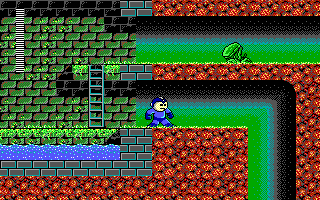
Once you drop into a stage, the absolute silence hits you. There is no sound card music track whatsoever, so you wander through twisting corridors accompanied only by PC speaker beeps whenever Mega Man fires his arm cannon or collides with a hazard. The controls do not help matters. Movement feels stiff, turning routine jumps over environmental traps into tense gambles because the engine responds to key presses with noticeable input delay.
Six fresh boss weapons and a surprisingly twisty level structure
Despite the technical flaws, the game attempts some genuine additions to the formula. You hunt down six original Robot Masters: Torch Man, Bit Man, Shark Man, Wave Man, Oil Man, and Blade Man. In an odd twist of history documented in the French Wikipedia entry for the title, Capcom would later reuse the names Torch Man, Wave Man, Oil Man, and Blade Man for completely different bosses in their official console main series years down the road. Defeating each boss awards their signature weapon, which you can equip to target boss weaknesses in the traditional rock-paper-scissors order.
The level design deviates heavily from the linear corridors of the console originals. Levels are twisting mazes filled with moving oil platforms, mutant bugs, walking plants, green monsters, classic Mets, and aggressive Sniper Joes. Mega Man can even swim through submerged water sections, a movement option that was not present in the classic NES titles. Navigating these aquatic passages offers a rare moment where the floaty physics actually feel appropriate to what is happening on screen.
Dr. Wily's castle is a single brutal gauntlet
If the stage select levels test your patience, the final stretch actively tests your sanity. Rather than splitting Dr. Wily's headquarters into four separate stages, the developers packed the entire finale into one continuous, sprawling level. You have to navigate a maze of traps, re-fight all six Robot Masters, and defeat three additional fortress bosses before finally confronting Dr. Wily himself.
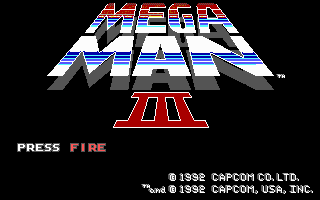
Enemy placement throughout the castle feels arbitrary and malicious. Traps and enemies sit at distances where they register hits on your health bar before you can react to their presence on the low-resolution screen. Contemporary retrospectives have treated the game with dry severity; Destructoid once quipped that playing it was only slightly worse than self-immolation, while USgamer framed trying the game as a warning for people who like to suffer. They were not entirely wrong, as a single bad jump near the end of Wily's fortress resets massive amounts of painful progress.
Try this forgotten DOS artifact for yourself
Nobody will ever confuse this DOS entry with Capcom's console high points, but that is precisely why it remains such a fascinating chapter in PC gaming history. It is a strange curiosity created during an era when computer ports were handled by small third-party teams working with tight budgets and minimal supervision. Seeing how Stephen Rozner adapted classic console mechanics to basic PC speaker hardware and low-end DOS machines is an intriguing look at early computer gaming trade-offs.
You can play Mega Man 3: The Robots are Revolting free in your browser right now with nothing to install and no setup. The heavy jumping controls and sparse PC speaker audio take some getting used to, but taking down Bit Man or Torch Man in this forgotten chapter is a rite of passage every fan should attempt at least once.
How Mega Man 3: The Robots are Revolting is played — the keys the game listens to, grouped by what they do.
- Movement
- Action
- Interface
Highlighted keys are mapped — hover or tap one to see what it does.
The control layout cannot be remapped in-game.
Players' controls
Touch and gamepad controls
The on-screen keyboard and gamepad mapping the browser player uses on a phone, a tablet or a controller, as opposed to the real keys above. $PRO members make their own in the player and share them here; anyone can pick one to play with.
Make your own touch controlsPRO
- 1Open the editorSign in below, then pick what to make. The game starts with the editor open over it.
- 2Place your keysAdd keys and drag them where your thumbs rest, or map a controller's buttons. Test plays the game with them; Save keeps them, and you play with them from then on.
- 3Share themShare them right after saving in the game, or name and share them here. Players vote, and the best become this game's controls for everyone.
Go PROSee how it worksSign in+20 XP for sharing · +50 XP if yours become the game's own
- The game's own controlsKeyboardGamepadWhat every player starts with.In use
2 screenshots
From the archive
No gameplay video yet
No gameplay video for Mega Man 3: The Robots are Revolting yet. Sign in to add one.
No reviews yet
Tell the community what you think of Mega Man 3: The Robots are Revolting. Reviews are public and tied to your username.
No archived manuals for Mega Man 3: The Robots are Revolting yet
No manuals archived for this title yet. Sign in to upload the first scan.
Cheat codes, console commands and memory pokes for Mega Man 3: The Robots are Revolting — each one verified and attributed.
Sign in to submitNo cheats yet for this title
Know a working cheat, poke or trainer? Add it with the button above. Moderators check every entry before it goes live.
No archived soundtrack for Mega Man 3: The Robots are Revolting yet
No soundtrack archived for this title yet. Sign in to upload the first rip.
No save states for Mega Man 3: The Robots are Revolting yet
No save states for this title yet. Sign in to share one.
Discussions
Sign in to post- Threads0
- Total posts0
- Online now6
Community · Mega Man 3: The Robots are Revolting
Who's contributing, and what's new
- Reviews0
- Threads0
- Uploadsapproved0
- Contributors0
Recent activity
Nothing here yet
Reviews, discussion threads and approved uploads appear here as members add them.