

Mega Man X
aka Rockman X
Rate this game
- Played
- A lot
Mega Man X brought fast-paced wall-jumping, charged arm cannons, and robot hunting to PC screens in 1995. While it translated the sharp platforming of the console original, playing this port on a computer came with distinct audio changes and tricky keyboard controls.
Dash, Wall-Jump, and the Maverick Stage Loop
The game kicks off on a crumbling highway in a ruined metropolis, immediately teaching you how to move. You control X, a Maverick Hunter android created by Dr. Light, working alongside your ally Zero to stop Sigma and his rogue army of Reploids. Unlike earlier games in the franchise where movement was stiff, here you can slide down walls, kick off vertical surfaces to gain height, and hit high speeds once you unlock the dash boots.
After clearing the introductory highway fight, you face eight open boss stages that can be tackled in any sequence. Each stage belongs to an animal-themed boss called a Maverick, including Chill Penguin, Flame Mammoth, Sting Chameleon, and Storm Eagle. Beating a boss awards you their specific weapon, which is often the direct weakness of another boss down the line. Defeating Chill Penguin, for instance, freezes the lava hazards inside Flame Mammoth's stage, rewarding players who plan their stage order carefully.
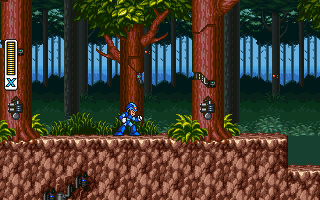
Stages also encourage exploration rather than straight linear runs. Hidden across the levels are Dr. Light capsules that grant permanent armor upgrades, alongside Heart Tanks that raise your maximum health capacity and Sub-Tanks that store excess health power-ups for later emergencies. You can even hop into heavy Ride Armor mech suits in specific zones to punch through reinforced enemies and walls.
When Sound Blaster MIDI Meets Alph Lyla
The transition from console hardware to the Mega Man X MS-DOS game introduced noticeable changes in sound design. Capcom's internal music team, Sound Team Alph Lyla, composed the original soundtrack, which relied heavily on synth guitars and punchy basslines. For the PC conversion, co-developed with Rozner Labs Software Group, those tracks were converted into standard General MIDI files.
If you ran the game on a standard Sound Blaster card, the driving rock compositions lost their low-end punch and gained a thinner, occasionally abrasive synth tone. The tracks stay catchy, but hearing the synth lead rendered by basic FM synthesis changes the mood of stages like Storm Eagle's tower. Physics and action speeds also exhibit slight quirks on PC hardware compared to the console original, making timing feel subtly different during tight jumps.
Secrets, Hadokens, and Stage Variety
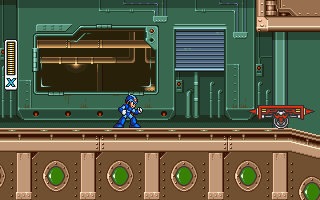
The level design hides genuine mechanical advantages in its secrets. Finding every upgrade capsule does far more than alter your armor; getting the arm part allows you to charge up both your standard X-Buster and any boss weapon you have collected. Capcom even hid an easter egg borrowed from Street Fighter: by collecting every hidden item and reaching a specific capsule with full health, X can execute a high-damage Hadoken fireball.
The core gameplay loop holds up well within the broader action game catalog. Switching between your default charged shot and boss weapons keeps combat dynamic, especially when managing energy meters for secondary gear during tough fights. It captures the fast side-scrolling style that defined PC side-scrollers in 1995 releases.
Why the Bosspider and Keyboard Controls Still Test Your Patience
The biggest roadblock in the game hits once you clear the eight primary stages and enter Sigma's fortress. The early fortress level features a boss known as the Bosspider, an enemy that drops down tracks at extreme speeds and leaves a tiny window for vulnerable hits. This single encounter creates a massive difficulty spike that stopped countless runs in their tracks.
Playing without a dedicated PC gamepad makes these end-game fights considerably harder. Mapping movement, dashing, weapon switching, and cannon charging across a standard keyboard requires uncomfortable finger contortions. Trying to hold a charged shot while wall-jumping away from boss attacks on a keyboard highlights how much the control scheme relies on traditional controller layouts.
Play Mega Man X Free in Your Browser Today
Despite the audio downgrades and the steep difficulty jumps in the fortress levels, the responsive movement and inventive boss gear make this a run worth taking. The stage progression system remains rewarding, and hunting down every hidden capsule gives the campaign plenty of replay value. You can experience this classic from Capcom directly on your modern computer without wrestling with original disk images or hardware setups.
You can play Mega Man X online, free in your browser, with nothing to install and no complex setup required. Fire up the browser player, remap your keys to suit your preferred layout, and see if you can take down Chill Penguin and survive the Bosspider tonight.
How Mega Man X is played — the keys the game listens to, grouped by what they do.
- Movement
- Weapons & items
- Interface
Highlighted keys are mapped — hover or tap one to see what it does.
Controls are reconfigurable in the game's setup utility (SETUP.EXE). The README references gamepad buttons (A, B, X, Y) for jump, dash, fire, and status screen, but defaults are not explicitly mapped to specific keyboard keys in the manual text.
Players' controls
Touch and gamepad controls
The on-screen keyboard and gamepad mapping the browser player uses on a phone, a tablet or a controller, as opposed to the real keys above. $PRO members make their own in the player and share them here; anyone can pick one to play with.
Make your own touch controlsPRO
- 1Open the editorSign in below, then pick what to make. The game starts with the editor open over it.
- 2Place your keysAdd keys and drag them where your thumbs rest, or map a controller's buttons. Test plays the game with them; Save keeps them, and you play with them from then on.
- 3Share themShare them right after saving in the game, or name and share them here. Players vote, and the best become this game's controls for everyone.
Go PROSee how it worksSign in+20 XP for sharing · +50 XP if yours become the game's own
- The game's own controlsKeyboardGamepadWhat every player starts with.In use
3 screenshots
From the archive
No reviews yet
Tell the community what you think of Mega Man X. Reviews are public and tied to your username.
No archived manuals for Mega Man X yet
No manuals archived for this title yet. Sign in to upload the first scan.
Cheat codes, console commands and memory pokes for Mega Man X — each one verified and attributed.
Sign in to submitNo cheats yet for this title
Know a working cheat, poke or trainer? Add it with the button above. Moderators check every entry before it goes live.
No archived soundtrack for Mega Man X yet
No soundtrack archived for this title yet. Sign in to upload the first rip.
No save states for Mega Man X yet
No save states for this title yet. Sign in to share one.
Discussions
Sign in to post- Threads0
- Total posts0
- Online now6
Community · Mega Man X
Who's contributing, and what's new
- Reviews0
- Threads0
- Uploadsapproved0
- Contributors0
Recent activity