
aka Dungeons of Despair · MacWizardry · Paladin · Sorcellerie: Le Donjon du Suzerain Heretique · Wizardry: Proving Grounds of the Mad Overlord!
Before you take your first step into Wizardry I: Proving Grounds of the Mad Overlord, you need a full six-person party, a graph paper notebook, and the cold acceptance that your favorite character might turn into a pile of unrecoverable ash.
When Andrew Greenberg and Robert Woodhead originally built their dungeon crawler on the Apple II in 1981, standard BASIC on IBM hardware was simply too sluggish to render a real-time vector maze. The developers held out for a proper Pascal runtime environment before porting the title over. That technical bottleneck delayed the 1984 release of the Andrew Greenberg, Inc. role-playing game on DOS.
When Sir-tech Software, Inc. finally put the game on IBM store shelves, it did not ship as a standard DOS executable. Instead, it came on a bootable diskette that bypassed MS-DOS entirely to manage system memory directly. Booting your machine off that floppy loaded stark monochrome vector lines framing a ten-level underground labyrinth. The presentation was bare and heavily menu-driven, but it offered precision that software running inside early DOS shells could not match.
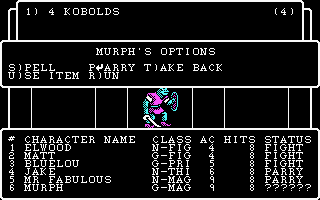
You begin in the surface town menu creating a party of six adventurers chosen from five races and three alignments. Base classes like Fighter, Priest, Mage, and Thief handle early survival. If your stats are high enough, you can eventually unlock elite classes such as Samurai, Lord, Bishop, or Ninja. Building a balanced front line is vital, because three characters absorb incoming physical attacks while the back row casts spells or hurls ranged attacks.
Exploring the maze is a lesson in cartography. Step into a dark sector without drawing your path on real graph paper and a invisible teleporter will quietly drop you five grid squares east into solid stone. Early combat encounters label monsters as shadowy figures like "unseen entity" until your party identifies them. Kobolds and Skeletons quickly give way to Will O' the Wisps and level-draining undead that can wipe away hours of hard-earned progress in a single round.
To survive the brutal difficulty, players quickly discovered a famous farming spot on the first floor. A fixed encounter with Murphy's Ghost deals low fixed damage while yielding huge experience rewards. Beating this spirit repeatedly became the standard grinding loop for early computer gamers trying to build a party strong enough to venture deeper into the maze.
The combat in this RPG is turn-based, swift, and completely unforgiving. Treasure chests drop after battles, but opening them is a nerve-wracking minigame of its own. Your Thief must inspect the chest to detect traps, then you must manually type out the exact trap name to disarm it. A single typo or failed check triggers poison needles or explosive gas that can instantly wipe your entire squad.
Death is rarely a simple inconvenience in the dungeon. If a party member falls, you have to drag their corpse back to the surface and pay the Temple of Cant for a resurrection attempt. If the priest fails the spell, your character turns to ash. If the second attempt fails on that ash, the character is deleted from your disk forever. Later floors introduce vampires and specters that permanently drain character levels, stripping away hard-earned attribute points without mercy.
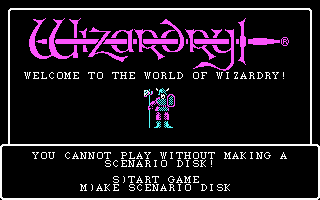
The lore of the labyrinth comes straight from internal jokes between the creators. The Mad Overlord Trebor and the evil archmage Werdna are simply the first names of Robert Woodhead and Andrew Greenberg spelled backward. Trebor lost his magical amulet to Werdna, who retreated into the bottom of a ten-level pit beneath the castle. Trebor promptly turned the dungeon into a training ground, ordering brave mercenaries to descend to floor ten and retrieve his stolen artifact.
Inside the maze, players could discover hidden pass-through walls and odd graffiti, including a famous wall carving that reads "TREBOR SUX". The extreme difficulty of reaching Werdna prompted third-party programmers to release save-editing tools like "Wizplus". Sir-tech fought back aggressively, warning in magazines that character editors would ruin the game's balance and voiding disk warranties for modified save files.
Despite the steep learning curve and punishing mechanics, the game set foundational standards for first-person dungeon exploration. Early magazine reviews praised its deep tactical choices, even as critics noted the sparse text-heavy displays and cumbersome interface. Its influence spread across continents, heavily inspiring early Japanese console RPG developers who adapted its party mechanics and dungeon layout format for decades to come.
While modern role-playing titles give you quest markers and instant saves, this classic tests your preparation, spatial memory, and risk management at every step. A quick ten-minute run is all it takes to experience the tension of disarming a trapped chest or mapping your first square of the maze.
You can play Wizardry I: Proving Grounds of the Mad Overlord online free in your browser right now with nothing to install and no complex setup. Load up this historic MS-DOS game, head straight to the tavern, roll six brave adventurers, and see how far down into Werdna's lair you can make it before your map runs out of grid paper.

Before you take your first step into Wizardry I: Proving Grounds of the Mad Overlord, you need a full six-person party, a graph paper notebook, and the cold acceptance that your favorite character might turn into a pile of unrecoverable ash.
When Andrew Greenberg and Robert Woodhead originally built their dungeon crawler on the Apple II in 1981, standard BASIC on IBM hardware was simply too sluggish to render a real-time vector maze. The developers held out for a proper Pascal runtime environment before porting the title over. That technical bottleneck delayed the 1984 release of the Andrew Greenberg, Inc. role-playing game on DOS.
When Sir-tech Software, Inc. finally put the game on IBM store shelves, it did not ship as a standard DOS executable. Instead, it came on a bootable diskette that bypassed MS-DOS entirely to manage system memory directly. Booting your machine off that floppy loaded stark monochrome vector lines framing a ten-level underground labyrinth. The presentation was bare and heavily menu-driven, but it offered precision that software running inside early DOS shells could not match.

You begin in the surface town menu creating a party of six adventurers chosen from five races and three alignments. Base classes like Fighter, Priest, Mage, and Thief handle early survival. If your stats are high enough, you can eventually unlock elite classes such as Samurai, Lord, Bishop, or Ninja. Building a balanced front line is vital, because three characters absorb incoming physical attacks while the back row casts spells or hurls ranged attacks.
Exploring the maze is a lesson in cartography. Step into a dark sector without drawing your path on real graph paper and a invisible teleporter will quietly drop you five grid squares east into solid stone. Early combat encounters label monsters as shadowy figures like "unseen entity" until your party identifies them. Kobolds and Skeletons quickly give way to Will O' the Wisps and level-draining undead that can wipe away hours of hard-earned progress in a single round.
To survive the brutal difficulty, players quickly discovered a famous farming spot on the first floor. A fixed encounter with Murphy's Ghost deals low fixed damage while yielding huge experience rewards. Beating this spirit repeatedly became the standard grinding loop for early computer gamers trying to build a party strong enough to venture deeper into the maze.
The combat in this RPG is turn-based, swift, and completely unforgiving. Treasure chests drop after battles, but opening them is a nerve-wracking minigame of its own. Your Thief must inspect the chest to detect traps, then you must manually type out the exact trap name to disarm it. A single typo or failed check triggers poison needles or explosive gas that can instantly wipe your entire squad.
Death is rarely a simple inconvenience in the dungeon. If a party member falls, you have to drag their corpse back to the surface and pay the Temple of Cant for a resurrection attempt. If the priest fails the spell, your character turns to ash. If the second attempt fails on that ash, the character is deleted from your disk forever. Later floors introduce vampires and specters that permanently drain character levels, stripping away hard-earned attribute points without mercy.

The lore of the labyrinth comes straight from internal jokes between the creators. The Mad Overlord Trebor and the evil archmage Werdna are simply the first names of Robert Woodhead and Andrew Greenberg spelled backward. Trebor lost his magical amulet to Werdna, who retreated into the bottom of a ten-level pit beneath the castle. Trebor promptly turned the dungeon into a training ground, ordering brave mercenaries to descend to floor ten and retrieve his stolen artifact.
Inside the maze, players could discover hidden pass-through walls and odd graffiti, including a famous wall carving that reads "TREBOR SUX". The extreme difficulty of reaching Werdna prompted third-party programmers to release save-editing tools like "Wizplus". Sir-tech fought back aggressively, warning in magazines that character editors would ruin the game's balance and voiding disk warranties for modified save files.
Despite the steep learning curve and punishing mechanics, the game set foundational standards for first-person dungeon exploration. Early magazine reviews praised its deep tactical choices, even as critics noted the sparse text-heavy displays and cumbersome interface. Its influence spread across continents, heavily inspiring early Japanese console RPG developers who adapted its party mechanics and dungeon layout format for decades to come.
While modern role-playing titles give you quest markers and instant saves, this classic tests your preparation, spatial memory, and risk management at every step. A quick ten-minute run is all it takes to experience the tension of disarming a trapped chest or mapping your first square of the maze.
You can play Wizardry I: Proving Grounds of the Mad Overlord online free in your browser right now with nothing to install and no complex setup. Load up this historic MS-DOS game, head straight to the tavern, roll six brave adventurers, and see how far down into Werdna's lair you can make it before your map runs out of grid paper.
How Wizardry I: Proving Grounds of the Mad Overlord is played — the keys the game listens to, grouped by what they do.
Highlighted keys are mapped — hover or tap one to see what it does.
The on-screen keyboard and gamepad mapping the browser player uses on a phone, a tablet or a controller, as opposed to the real keys above. $PRO members make their own in the player and share them here; anyone can pick one to play with.
Cheat codes, console commands and memory pokes for Wizardry I: Proving Grounds of the Mad Overlord — each one verified and attributed.
Sign in to submitHow Wizardry I: Proving Grounds of the Mad Overlord is played — the keys the game listens to, grouped by what they do.
Highlighted keys are mapped — hover or tap one to see what it does.
The on-screen keyboard and gamepad mapping the browser player uses on a phone, a tablet or a controller, as opposed to the real keys above. $PRO members make their own in the player and share them here; anyone can pick one to play with.
Cheat codes, console commands and memory pokes for Wizardry I: Proving Grounds of the Mad Overlord — each one verified and attributed.
Sign in to submit
Wizardry I: Proving Grounds of the Mad Overlord1984 · this page