
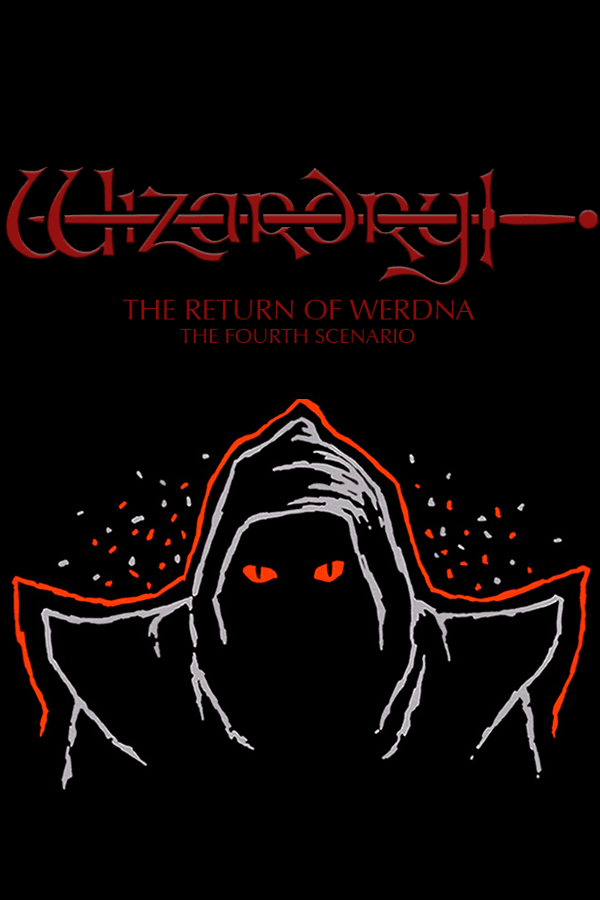

Playing Wizardry IV: The Return of Werdna turns the classic dungeon crawl upside down by casting you as the defeated final boss trying to escape his own tomb.
You start at the bottom of a ten-level underground vault, completely stripped of your magical powers. In the original Wizardry, you played the hero party invading Werdna’s lair to steal his amulet. Now, as Werdna himself, you wake up in a coffin surrounded by the exact traps, drop-chutes, and wireframe corridors you built to keep invaders out.
Because Werdna starts without any spells, you cannot survive a fight alone. Progress depends on reaching pentagrams scattered across each floor. Stepping on a pentagram restores your health, raises your power level, and lets you summon squads of monsters to march ahead of you into combat.
Instead of randomly generated beasts, your enemies are pre-built parties of self-righteous adventurers. Sir-Tech created these enemy parties by pulling real character data off disks that fans and playtesters had mailed in for disk recovery. Getting ambushed by a level-10 Ninja party named after actual early PC gamers is a brilliant touch, but combat is brutally unforgiving.
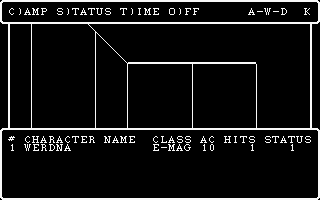
Designer Roe R. Adams III created puzzles that actively punished standard mapping habits. The level designs feature non-Euclidean geometry, hidden one-way doors, and invisible spinner tiles that silently reorient your facing direction. Many players in 1988 gave up before even finding the exit to the very first room.
The constant threat roaming the halls is Trebor's Ghost. Trebor passes straight through solid walls, and if his icon touches Werdna, your run ends instantly. Dispelling him requires finding specific quest items, such as the relic of Saint Trebor, which forces you to solve cryptic inventory riddles while constantly on the move.
Saving your game carries a mean twist. Restoring your state at a pentagram instantly resurrects every enemy adventuring party you defeated on that level. If you step back into a corridor you just cleared, you have to fight through those exact same heroes all over again.
By the time this 1988 MS-DOS version hit shelves, the underlying engine was showing serious age. Sir-Tech built the title on the original Apple Pascal framework created years earlier. Compared to contemporary releases like The Bard's Tale, the austere black-and-white wireframe view looked primitive.
Combat relies heavily on dice rolls that can turn sour instantly. Enemy mages often open battle by casting high-level damage spells like Tiltowait. Because Werdna’s death causes an immediate game over regardless of how many summoned demon allies remain standing, a single turn of bad spell initiative forces a reload.
Computer Gaming World writer Scorpia famously praised the game for being balanced and fair once a player understood its internal logic. Yet the sheer difficulty scared away the general public. Co-founder Robert Sirotek later acknowledged that it was the lowest-selling product the company ever released, forcing the studio to overhaul its design strategy for future role-playing (RPG) games.
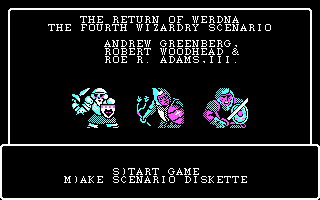
Despite the steep curve, reaching the surface rewards you with genuine narrative variety. The game features five distinct endings based on actions taken and items carried during your escape. You can trigger a good ending, an evil ending, or the secret Grandmaster ending, which requires solving the game's hardest optional riddle sequence.
Inside jokes and playtester tributes fill the text prompts. You will run into fountain memorials and named NPCs honoring prominent playtesters like Ronald Wartow and Scorpia herself. You can read more about the development history on the Wikipedia page for Wizardry IV.
The ruthless puzzle design and sharp combat decisions still deliver a unique test of patience that later games never replicated. You can play Wizardry IV: The Return of Werdna online free in your browser right now. Having Werdna's dark spell list at your fingertips while dodging Trebor's Ghost is something you have to control yourself to appreciate.

Playing Wizardry IV: The Return of Werdna turns the classic dungeon crawl upside down by casting you as the defeated final boss trying to escape his own tomb.
You start at the bottom of a ten-level underground vault, completely stripped of your magical powers. In the original Wizardry, you played the hero party invading Werdna’s lair to steal his amulet. Now, as Werdna himself, you wake up in a coffin surrounded by the exact traps, drop-chutes, and wireframe corridors you built to keep invaders out.
Because Werdna starts without any spells, you cannot survive a fight alone. Progress depends on reaching pentagrams scattered across each floor. Stepping on a pentagram restores your health, raises your power level, and lets you summon squads of monsters to march ahead of you into combat.
Instead of randomly generated beasts, your enemies are pre-built parties of self-righteous adventurers. Sir-Tech created these enemy parties by pulling real character data off disks that fans and playtesters had mailed in for disk recovery. Getting ambushed by a level-10 Ninja party named after actual early PC gamers is a brilliant touch, but combat is brutally unforgiving.

Designer Roe R. Adams III created puzzles that actively punished standard mapping habits. The level designs feature non-Euclidean geometry, hidden one-way doors, and invisible spinner tiles that silently reorient your facing direction. Many players in 1988 gave up before even finding the exit to the very first room.
The constant threat roaming the halls is Trebor's Ghost. Trebor passes straight through solid walls, and if his icon touches Werdna, your run ends instantly. Dispelling him requires finding specific quest items, such as the relic of Saint Trebor, which forces you to solve cryptic inventory riddles while constantly on the move.
Saving your game carries a mean twist. Restoring your state at a pentagram instantly resurrects every enemy adventuring party you defeated on that level. If you step back into a corridor you just cleared, you have to fight through those exact same heroes all over again.
By the time this 1988 MS-DOS version hit shelves, the underlying engine was showing serious age. Sir-Tech built the title on the original Apple Pascal framework created years earlier. Compared to contemporary releases like The Bard's Tale, the austere black-and-white wireframe view looked primitive.
Combat relies heavily on dice rolls that can turn sour instantly. Enemy mages often open battle by casting high-level damage spells like Tiltowait. Because Werdna’s death causes an immediate game over regardless of how many summoned demon allies remain standing, a single turn of bad spell initiative forces a reload.
Computer Gaming World writer Scorpia famously praised the game for being balanced and fair once a player understood its internal logic. Yet the sheer difficulty scared away the general public. Co-founder Robert Sirotek later acknowledged that it was the lowest-selling product the company ever released, forcing the studio to overhaul its design strategy for future role-playing (RPG) games.

Despite the steep curve, reaching the surface rewards you with genuine narrative variety. The game features five distinct endings based on actions taken and items carried during your escape. You can trigger a good ending, an evil ending, or the secret Grandmaster ending, which requires solving the game's hardest optional riddle sequence.
Inside jokes and playtester tributes fill the text prompts. You will run into fountain memorials and named NPCs honoring prominent playtesters like Ronald Wartow and Scorpia herself. You can read more about the development history on the Wikipedia page for Wizardry IV.
The ruthless puzzle design and sharp combat decisions still deliver a unique test of patience that later games never replicated. You can play Wizardry IV: The Return of Werdna online free in your browser right now. Having Werdna's dark spell list at your fingertips while dodging Trebor's Ghost is something you have to control yourself to appreciate.
aka Wizardry: The Return of Werdna - The Fourth Scenario · The Return of Werdna: The Fourth Wizardry Scenario
How Wizardry IV: The Return of Werdna is played — the keys the game listens to, grouped by what they do.
Highlighted keys are mapped — hover or tap one to see what it does.
The on-screen keyboard and gamepad mapping the browser player uses on a phone, a tablet or a controller, as opposed to the real keys above. $PRO members make their own in the player and share them here; anyone can pick one to play with.
Cheat codes, console commands and memory pokes for Wizardry IV: The Return of Werdna — each one verified and attributed.
Sign in to submitHow Wizardry IV: The Return of Werdna is played — the keys the game listens to, grouped by what they do.
Highlighted keys are mapped — hover or tap one to see what it does.
The on-screen keyboard and gamepad mapping the browser player uses on a phone, a tablet or a controller, as opposed to the real keys above. $PRO members make their own in the player and share them here; anyone can pick one to play with.
Cheat codes, console commands and memory pokes for Wizardry IV: The Return of Werdna — each one verified and attributed.
Sign in to submit
Wizardry V: Heart of the Maelstrom#5 · 1988