

Wizardry II: The Knight of Diamonds
aka Sorcellerie: Le Chevalier de Diamant · Wizardry: Scenario #2 - The Knight of Diamonds · Wizardry 2: The Knight of Diamonds · ウィザードリィIII・ダイヤモンドの騎士
Rate this game
- Played
- A lot
Taking your fresh party into Wizardry II: The Knight of Diamonds without transferring high-level veterans from the first game is a swift execution notice, as Sir-tech Software built this six-floor labyrinth exclusively for hardened survivors.
Taking on Wizardry II: The Knight of Diamonds without an imported party is financial suicide
When designers Andrew C. Greenberg and Robert Woodhead crafted this follow-up at Sir-tech Software, Inc., they did not design a traditional onboarding process. The story picks up after the death of the Mad Overlord Trebor and the villain Werdna. A new usurper named Davalpus slaughtered the royal family before being struck down by the Prince, who wielded the Staff of Gnilda and the magical armor of the Knight of Diamonds. The deity Gnilda, furious over the bloody infighting, reclaimed the staff and cached it beneath a monster-infested temple. To retrieve it and safeguard the realm from foreign invaders, you must recover all five pieces of the knight's gear from guardians hidden inside the maze.
The core problem for anyone booting up the MS-DOS version of Wizardry II: The Knight of Diamonds from scratch is the balance curve. The game expects your adventuring party to begin at level 13 or higher, carrying over equipment and spellbooks from Wizardry: Proving Grounds of the Mad Overlord. If you construct a set of fresh level 1 adventurers at the tavern, the first encounter on floor one will wipe them out instantly. That strict requirement led reviewer Scorpia in Computer Gaming World to label it a disappointing sequel, viewing the release more as an aggressive expansion pack than a standalone adventure.
Yet for players who had spent months grinding through the original release, this design bypassed early-game fluff. Built on the same Apple Pascal engine that powered its predecessor, the software added a few key mechanical tweaks for the PC release, including the ability to save your game mid-dungeon rather than only back at the city castle. The spell potency was retuned, but the core engine, visual layout, and interface remained identical.
Six levels of dense mapping, dark zones, and deadly spin tiles
Exploration relies entirely on first-person grid movements. Without an in-game automap or any built-in direction hints, success depends on keeping physical graph paper beside your keyboard. The labyrinth under the Temple of Gnilda contains six floor levels, but do not let the smaller floor count fool you. The level geometry relies heavily on tricks designed to disorient you, including unlit dark zones, silent turn tiles that rotate your party without altering your perspective, and secret doors concealed within solid stone walls.
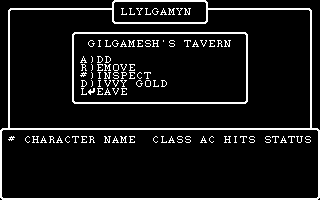
The traversal rules are significantly tighter than in the first game. You will find no convenient elevator shafts to bypass middle floors, forcing your six-character party to walk every stretch of damp corridor. If you attempt to use high-level Mage teleportation spells to warp directly to an unvisited floor, the spell fails automatically. You must step on every single tile manually to register it as explored territory before fast-travel magic will accept the destination.
Managing your group composition is a deep exercise in bookkeeping across five character races and eight specialized classes:
- Frontline Fighters, Samurai, and Lords absorb heavy physical punishment while dealing direct melee damage.
- Sneaky Thieves and Ninjas disarm chest traps and spot hidden hazards along the corridors.
- Devout Priests and Bishops supply defensive blessings, cure paralyzing ailments, and keep the party alive.
- Arcane Mages deliver area-of-effect elemental combat spells across fifty total magic options.
Audio feedback on standard IBM hardware stays minimal. Sound output relies entirely on PC speaker clicks, chirps, and blunt tonal beeps during interface navigation and turn transitions, leaving the atmosphere quiet and tense as you map out blind corners.
The hunt for armor pieces and the threat of total party loss
Progress through the maze revolves around locating five unique items: the KOD shield, armor, helm, gauntlets, and sword. Each piece is tied to specific encounters or trading events buried within the dungeon floors. These items are living entities that will put up a brutal fight before surrendering. Only when a single character equips the complete set can your party interact with the Staff of Gnilda to complete the campaign.
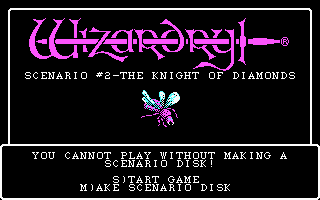
While magazine reviews in Softline praised the variety of enemy monster encounters and distinct floor tasks, modern players often balk at the extreme stakes. If your entire party falls in battle deep on floor five, there is no automatic checkpoint to reload. Their bodies remain on that exact tile. You must send a secondary party of high-level backup characters into the depths to recover their corpses and carry them back to the temple for expensive resurrection attempts.
If your rescue team also dies, or if you do not have high-level backup characters available, those original heroes are effectively gone. Many players faced with a total wipe had to return to the original Wizardry to grind a fresh crew from level 1 all the way back up to level 13 just to recover their lost items. Combined with an ending sequence that many long-time players consider flat and anti-climactic, reaching the final victory screen demands genuine persistence.
How this classic MS-DOS crawler holds up today
As an early entry in the role-playing (RPG) games space, this 1987 release from Sir-tech Software, Inc. strips away narrative distraction in favor of raw tactical combat and spatial navigation. The heavy dependency on imported saves makes it a punishing prospect for casual curious players, but for enthusiasts of hard-nosed grid crawling, its dense maze design presents a fantastic mental puzzle.
You can play Wizardry II: The Knight of Diamonds free in your browser right now, with no setup required. If you choose to launch the game without importing a veteran squad from the first entry, prepare for immediate defeat on floor one. Grab a sheet of graph paper, keep your Priest's healing spells ready, and approach every unexplored corner with healthy respect.
Players' controls
Touch and gamepad controls
The on-screen keyboard and gamepad mapping the browser player uses on a phone, a tablet or a controller, as opposed to the real keys above. $PRO members make their own in the player and share them here; anyone can pick one to play with.
Make your own touch controlsPRO
- 1Open the editorSign in below, then pick what to make. The game starts with the editor open over it.
- 2Place your keysAdd keys and drag them where your thumbs rest, or map a controller's buttons. Test plays the game with them; Save keeps them, and you play with them from then on.
- 3Share themShare them right after saving in the game, or name and share them here. Players vote, and the best become this game's controls for everyone.
Go PROSee how it worksSign in+20 XP for sharing · +50 XP if yours become the game's own
- The game's own controlsNone yet: played with a real keyboard only.In use
2 screenshots
From the archive
No gameplay video yet
No gameplay video for Wizardry II: The Knight of Diamonds yet. Sign in to add one.
No reviews yet
Tell the community what you think of Wizardry II: The Knight of Diamonds. Reviews are public and tied to your username.
No archived manuals for Wizardry II: The Knight of Diamonds yet
No manuals archived for this title yet. Sign in to upload the first scan.
Cheat codes, console commands and memory pokes for Wizardry II: The Knight of Diamonds — each one verified and attributed.
Sign in to submitNo cheats yet for this title
Know a working cheat, poke or trainer? Add it with the button above. Moderators check every entry before it goes live.
No archived soundtrack for Wizardry II: The Knight of Diamonds yet
No soundtrack archived for this title yet. Sign in to upload the first rip.
No save states for Wizardry II: The Knight of Diamonds yet
No save states for this title yet. Sign in to share one.
Discussions
Sign in to post- Threads0
- Total posts0
- Online now6
Community · Wizardry II: The Knight of Diamonds
Who's contributing, and what's new
- Reviews0
- Threads0
- Uploadsapproved0
- Contributors0
Recent activity
Nothing here yet
Reviews, discussion threads and approved uploads appear here as members add them.